The DeepSeek Files API went live on 21 August 2026 alongside the DeepSeek-V4-Flash-Vision-Exp model, and according to the official announcement it is free to use: you upload an image once, get back a file id, and then reference that file id in every future request instead of re-sending the image — which saves request bandwidth on every single call after the first. If you are building anything that looks at the same screenshots, charts or documents more than once — agents, audits, monitoring, content pipelines — this is the quiet release that changes your day-to-day costs and speed, and in this guide I will walk through exactly what shipped, how the upload-once workflow operates, and where it earns its keep in a real business.
📺 Watch: NEW DeepSeek V4 Flash Vision Exp is ABSOLUTELY INSANE!
🔥 Get the Agent OS as a free bonus: AI Profit Boardroom members get the full Agent OS zip, prompt libraries, daily tutorials and weekly live coaching calls. → Get inside
I have been running my content and SEO operations on DeepSeek's V4 family for months because the economics are absurd, and the one thing that always felt wasteful was pushing the same image up the wire again and again. According to the release notes, that is precisely the problem the Files API exists to solve. Everything below comes straight from the official DeepSeek API announcement and docs, plus my own experience running DeepSeek inside my agent stack.
What the DeepSeek Files API Actually Shipped
Per the official DeepSeek announcement on 21 August 2026, the Files API launch includes three headline facts:
- It is free. The announcement states the Files API is free to use — there is no separate storage or upload charge listed.
- Upload once, reference forever. You upload an image one time, then reference it by its file id in subsequent requests to save request bandwidth. The same image can be reused across requests with no need to upload it again.
- It landed with vision. The Files API arrived in the same release as DeepSeek-V4-Flash-Vision-Exp, the experimental multimodal model, and it is one of three supported ways to hand images to that model — alongside base64 encoding and external URLs.
That third point matters for context. I have already published a full breakdown of the DeepSeek V4 Flash Vision Exp release — what the model is, what the benchmarks show, and how image billing works — so I will not repeat that here. This page is about the workflow piece: how you feed images into that model efficiently, because the Files API is the difference between a vision pipeline that scales and one that quietly bleeds bandwidth.
How the Upload-Once Workflow Operates
The mechanics, as the official docs describe them, are simple enough to explain in one paragraph. You send your image to the Files API endpoint once. DeepSeek stores it and returns a file id. From that point on, any request to the multimodal API can reference the file id instead of carrying the full image payload. The model treats it exactly as if you had sent the image directly — same output, same quality — but your request is a fraction of the size.
Three input routes now exist for images on the DeepSeek platform, according to the announcement:
| Input method | How it works | Best for |
|---|---|---|
| Base64 | Encode the image into the request body itself | One-off requests where the image is never reused |
| External URL | Point the API at an image hosted on the web | Images already living on a public server |
| Files API | Upload once, reference by file id in every later request | Any image you will send more than once |
The decision rule I use is embarrassingly simple: if there is any chance an image gets analysed twice, it goes through the Files API. A dashboard screenshot your agent checks every morning, a competitor's pricing page you monitor weekly, a set of product photos you run through multiple prompts — all of these are upload-once candidates. The only images I still send as base64 are genuine one-offs.
If you want my full DeepSeek agent stack — the exact pipelines, prompts and workflows I run daily, plus the Agent OS bundle as a free bonus — I walk members through it inside AI Profit Boardroom → Get my DeepSeek pipelines
Why This Matters for Vision Costs
Here is where the Files API and the vision release fit together. According to the official announcement, images sent to DeepSeek-V4-Flash-Vision-Exp are tokenised for billing at up to 384 tokens per image, charged at standard V4-Flash pricing. The Files API does not change that per-image token price — what it removes is the repeated upload overhead: the bandwidth, the request size and the latency of pushing the same bytes to the platform on every call.
📺 Watch: DeepSeek Just Made V4 Flash 10X Better
In an agent context that overhead compounds fast. A vision-driven agent loop might look at the same reference screenshot ten or twenty times across a session as it works through a task. Upload once, reference by file id, and every one of those calls gets lighter. I am obsessive about this sort of thing — trimming context and payload waste is one of the highest-leverage habits in agent work, the same reason I wrote up how to reduce Claude Code token usage — and the Files API bakes that habit into DeepSeek's platform at the infrastructure level.
Where the DeepSeek Files API Earns Its Keep
Practical use cases where the upload-once pattern pays off immediately:
- Screenshot-driven agents. Per the announcement, V4-Flash-Vision-Exp works across agent frameworks and combines visual understanding with tools. Any agent that keeps referring back to the same screenshot — a design it is implementing, a dashboard it is monitoring — should hold that image as a file id, not a payload.
- Document and chart analysis. Upload a scanned document or chart once, then hit it with as many different prompts as you like: summarise it, extract the numbers, compare it against last month's version. One upload, unlimited angles.
- Batch content workflows. My content pipelines regularly run one image through several prompt variants — alt text, description, analysis, repurposing. With file ids, the image goes up once and the variants are just lightweight text requests.
- Multi-round conversations. A chat that keeps an image in play across many turns no longer needs to re-carry that image; the file id keeps the conversation light.
Because DeepSeek Harness 0.1.1 shipped the same day with out-of-the-box support for the new vision model — that is straight from the release notes — the harness route is the fastest way to get a working vision agent that benefits from all of this. I have covered the DeepSeek Harness in depth separately if you are starting from zero.
📺 Watch: NEW DeepSeek Harness is Crazy Good! (Run it LOCALLY!)
How I Slot This into My Own Stack
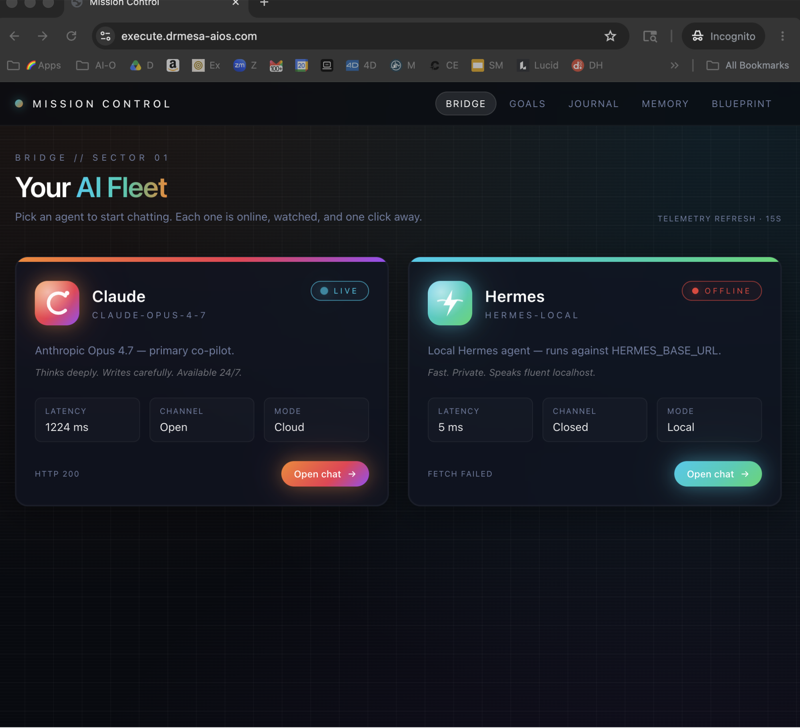
My operating system for all of this is the Agent OS — my own framework for running agents with shared memory, mission control and orchestration — and the Files API slots into it as the image layer for anything DeepSeek-powered. Reference images my agents need repeatedly get uploaded once and logged by file id, and from then on every agent that needs eyes on that image just passes the reference.
On model quality: I benchmark every model I use on Goldie Bench, my own testing suite, and the pattern that keeps repeating is that pipeline efficiency compounds harder than raw model quality for most business tasks. A slightly weaker model in a lean, well-fed pipeline out-delivers a stronger model in a wasteful one. The Files API is exactly that kind of lean-pipeline win: zero glamour, permanent benefit. It is the same philosophy behind file-based agent memory, which I break down in my Hermes memory system guide — boring infrastructure choices are usually the ones that compound.
DeepSeek Files API FAQs
What is the DeepSeek Files API?
It is DeepSeek's file upload service, launched 21 August 2026 alongside the V4-Flash-Vision-Exp model. According to the official announcement it is free to use: you upload an image once, receive a file id, and reference that id in future API requests instead of re-uploading the image.
Does the Files API cost anything?
The official announcement states the Files API is free to use. Image analysis itself is billed normally — per the release notes, images are tokenised at up to 384 tokens each at V4-Flash pricing when processed by the vision model.
Which models work with Files API images?
The announcement pairs the Files API with DeepSeek-V4-Flash-Vision-Exp, the experimental multimodal model released the same day, which accepts images via base64, external URLs or the Files API and supports mixed text-and-image input.
Can I reuse the same uploaded image across different requests?
Yes — that is the whole point. Per the official docs, the same image can be reused across requests by its file id, with no need to upload it again.
Should I still use base64 for images?
For genuine one-off images, base64 remains the simplest route. For anything you will analyse more than once, the file id workflow saves bandwidth on every request after the first.
Verdict: Small Release, Compounding Win
The DeepSeek Files API is not a flashy launch — no benchmark charts, no new model weights — but it is the kind of infrastructure release that makes every vision workflow you build on DeepSeek permanently cheaper and faster to run. Free uploads, file id reuse, and a straight line into the new vision model: if you are doing anything image-heavy on the V4 family, switch your repeated images to file ids this week and pocket the savings forever.
Want the full build — my DeepSeek vision pipelines, the Agent OS, prompt libraries, daily tutorials and weekly live coaching calls? Join me inside AI Profit Boardroom → Start building with my stack