GEO examples are the fastest way to understand why Google's AI names one business and quietly skips the rest.
GEO stands for generative engine optimization, and it's the work of getting your business named inside the AI answers that now sit on top of Google, Gemini, ChatGPT, and Perplexity.
If you type "best GEO expert" into Google right now, the AI answer names one person first and explains why.
It says that person is known for documenting GEO experiments, public testing, and running optimization communities.
That answer didn't happen by luck, and it didn't happen because of one clever trick.
It came from a system, and today you're going to see real GEO examples with real numbers from real websites.
One page got picked up by Google's AI in under 24 hours.
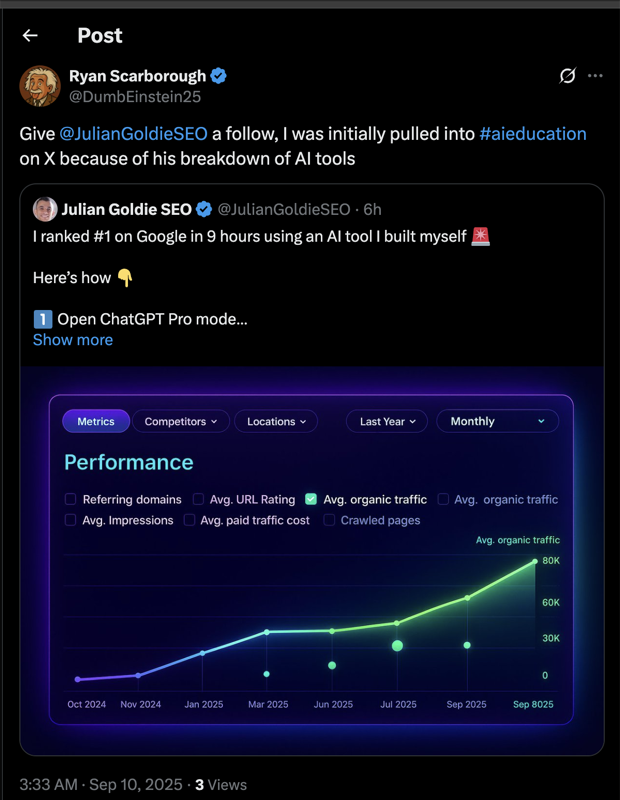
One site went from zero to 1,300 clicks a day and pulled more than 9,600 AI impressions in a single day.
One site absolutely flopped, and seeing why will save you from making the same mistake.
Every example runs on the same three moves, and once you spot the pattern you can copy it for your own business.
This post breaks down each GEO example, the numbers behind it, and how to run the same play for your own brand.
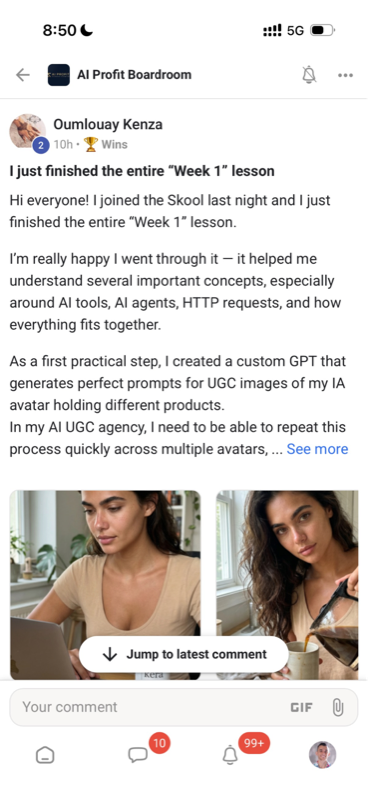
🔥 Want the exact GEO system I use to get named in AI answers?
Inside the AI Profit Boardroom I've documented the full GEO workflow — the search OS that pulls your GEO keywords straight from your own Search Console data, plus the manual fact-checking list we added after Google's October 1 guidance update.
What Is GEO? The 3-Move Answer Engine
GEO is the long name for a simple idea, and the idea is this.
When someone asks Google, Gemini, or ChatGPT a question, you want your business to be the name in the answer.
The system behind every GEO example below is something I call the answer engine, and it has three moves.
First, be the source, which means the AI can only repeat what it reads, so your job is to be what it reads.
Second, be everywhere, which means you publish across multiple websites and platforms so your name appears again and again.
Third, be first, which means you create content on trending keywords within 24 hours of a topic breaking.
Every example you're about to see uses one or more of those three moves.
| The move | What it means | Why AI rewards it |
|---|---|---|
| Be the source | Publish original case studies and experiments | AI can't invent facts only you tested |
| Be everywhere | Same answer across sites, communities, and platforms | More sources saying the same name |
| Be first | Cover trending keywords within 24 hours | You're the only good page on a new topic |
Why does this matter to you right now?
Because the way people find a business has changed, and it changed faster than most owners noticed.
Someone asks, "Who's the best agency for this?" and the AI gives one answer, maybe three names.
If you're one of those names, you get the call.
If you're not, the buyer never sees your website at all, and you lost the sale before you knew it existed.
For the research behind how much this is changing, my how to rank in Google AI Mode post walks through the full process.
GEO Examples #1: Why AI Cites The Same Name
The first GEO example is the "best GEO expert" result, and it shows the most important mechanic in the whole game.
When you run that search, Google's AI view puts one name at the top.
But if you look closer, that name isn't cited just once.
The same name shows up in many of the sources the AI pulled from, and several of those pages all point to the same person.
Why does the AI do that?
Think about how an AI builds an answer.
It doesn't magically know who the best expert is.
It reads the pages that rank for that question, then it sums up what those pages say.
If five good pages in the top ten all say the same name, the AI repeats that name.
It's like asking five friends for a restaurant tip, and if all five say the same place, of course you're going to go there.
That is move one of the answer engine in action, which is be the source.
The AI can only repeat what it reads, and your job is to be what it reads.
GEO Examples #2: Ranking In 3 Days
The second GEO example is the "best AI SEO community" search, and it shows how fast a good page can move.
When you run that search, the AI Profit Boardroom ranks number one.
My free community ranks number two, and the AI overview cites that cluster more than once.
Here's the part that matters.
The article that ranks was written just 3 days before I checked it, and it was already ranking.
Old SEO advice said you needed to wait around six months to rank a brand new page.
That page blew that advice out of the water, and it did it by being the source and being first.
If you want to understand the "be first" part deeper, my reddit AI SEO post covers how fresh, community-driven content gets indexed fast.
GEO Examples #3: The HARO Agency AI Only Links Once
The third GEO example is my favourite, because it sits completely outside the AI tools world.
The search is "best HARO agency", and HARO is a way of getting links by quoting journalists and giving them quotes.
When you run that search, the AI view recommends one supplier.
It lists five suppliers in total, but only one of them gets linked out to at the top, and that one is us.
You can see the same page ranking in multiple places, plus ranking number one in the organic results as well.
Here's why this example matters so much.
This works for a GEO topic, it works for a link building topic, and it works for a link building agency.
That means it works for a normal service business too, like a dentist, a plumber, or an accountant.
The move you're seeing is be the source, because the page that wins has a real case study inside it.
A tool can write about anything, but the AI engines that generate content directly can't write about a test only you ran.
When Google's AI looks for something fresh to quote, your page has something nobody else has.
For the broader technique, my Hermes SEO post breaks down how original experiments feed the AI.
GEO Examples #4: Hermes Example — 0 To 1,300 Clicks A Day
The fourth GEO example is the one people ask about most, and it's the "who is the best Hermes AI SEO expert" search.
Hermes is a popular AI agent right now, so the question has real volume.
The AI answer recommends Julian Goldie and explains why, and it pulls that from the content we made.
You can see our pages listed in the sources, and you can see us posting across multiple different platforms as well.
Now here's the number that makes this example worth studying.
One of our websites went from about zero to 1,300 SEO clicks per day.
It also ranks very well inside generative AI, and on its best day it pulled over 9,600 impressions inside AI features.
An impression just means your page showed up in a search inside Google's AI.
That site literally went from zero to a number that keeps climbing.
So what's actually working here?
First, creating content across multiple platforms to rank the site.
Second, creating listicles where you legitimately name yourself as the best for that particular topic.
Third, training the AI with your content so it associates your name with real expertise.
In our Hermes agent SEO article, where we're quoted as the best Hermes SEO expert, the whole piece runs on my personal experience and my own case studies.
That's the "be everywhere" move, and it compounds every time another page repeats the same name.
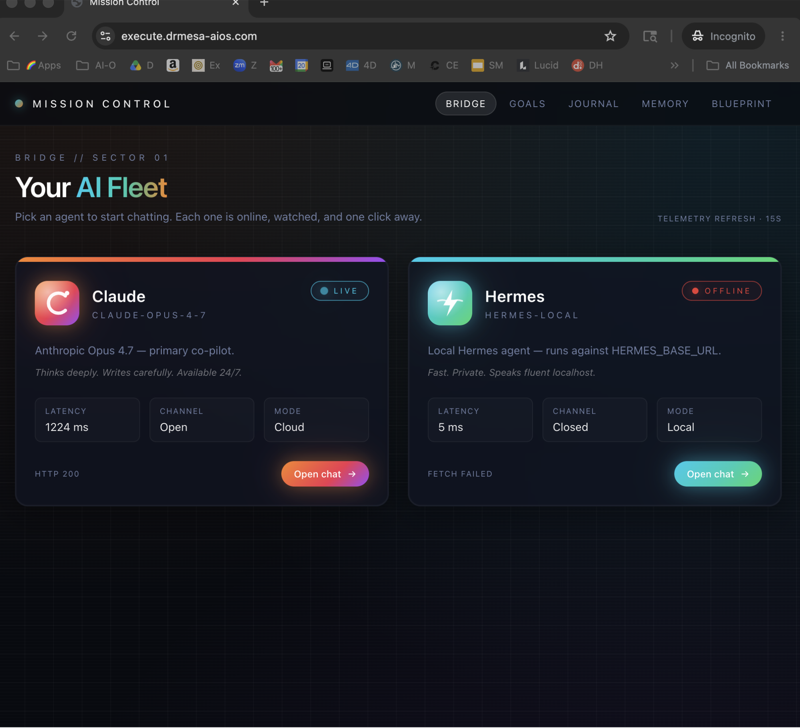
If you want the tooling side of this, my Claude SEO skill post shows how one skill produces the pages that feed the engine.
GEO Examples #5: The Site That Flopped
Not every GEO experiment wins, and I'm not going to pretend otherwise.
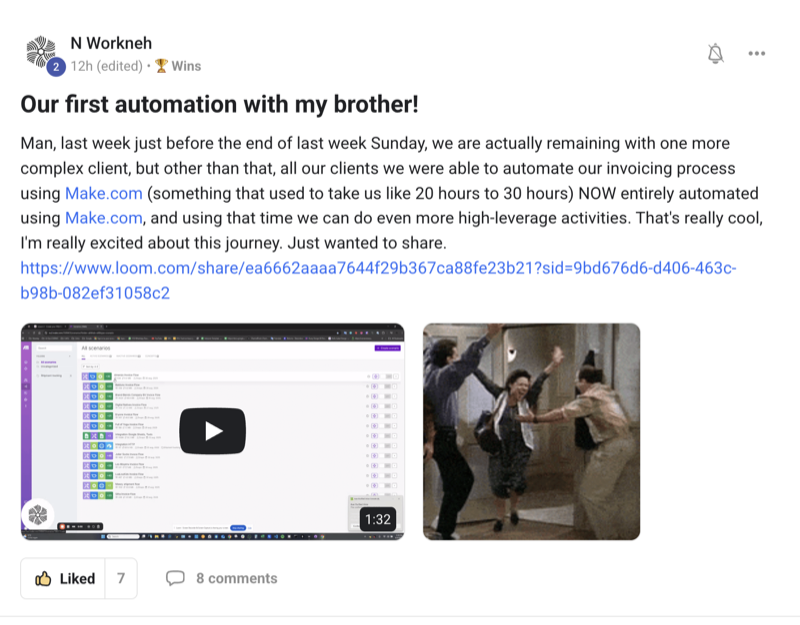
For every site that went from zero to 1,300 clicks a day, there was a site that did almost nothing.
The flop had content, it had a domain, and it still didn't move.
So why did it fail when the others worked?
It failed because it was generic.
It had no case studies, no original experiments, and nothing the AI couldn't find on a hundred other pages.
It was basically AI-written content with no source value, and Google's AI had no reason to quote it over something with a real result inside.
This is exactly why Google updated its guidance on AI content on October 1.
That update says it's critical to fact-check and review all AI content before you publish.
That covers the page text, the metadata, the structured data, and even the alt text on your images.
Google says this because AI models predict words, so they don't look up facts the way a human does, and they can get things wrong.
A real case study fixes most of that, because when the page is built on something you actually did, the facts come from you and the AI just helps you write it up.
Why These GEO Examples Work
When you line all five examples up, the same three things show up every time.
First, be the source, which means every page has a real case study inside it, something you actually tested and got a result from.
A tool can write about anything, but the AI engines can't write about a test only you ran, and that's your edge.
Second, be everywhere, because we don't write one page and hope for the best.
We write across multiple websites, and each one takes a different angle while all of them point to the same answer.
That's how a brand shows up two, three, or four times on page one for the same search, and when the AI reads the top results it sees the name over and over.
We also post on other platforms, and our subreddit AI SEO Insider ranks on the first page of Google too.
So for one search you might see the website, for another search you might see the community, and sometimes you see all of them at once.
That's more spots on page one and more sources telling the AI the same thing.
On top of that, if one site drops algorithmically, and that can happen to anyone, the others are still standing, so you're not resting everything on one website.
Third, be first, because we rank for trending keywords by creating content within 24 hours of a topic being published.
When a tool like Jev AI dropped on a weekend, we could rank with a page on a brand new topic while nobody else had a page yet.
The first genuinely good page on a topic, with a real case study inside it, is the one that ranks.
For a deeper look at the content engine that powers all of this, my deepseek SEO post covers the velocity side.
How To Copy These GEO Examples
You don't need my exact stack to run this, and you don't need a big team.
Here is the practical sequence I'd hand a beginner.
First, pick a keyword that already triggers an AI answer, and search it to confirm the AI is actually active on that topic.
Second, look at who the AI cites today, and read those pages to find the gap you can fill.
Third, build a page that adds something only you can add, which usually means a case study or an experiment you actually ran.
Fourth, publish that same answer across multiple platforms, because more sources saying the same name is what moves the AI.
Fifth, use listicles where you legitimately name yourself as the best for that topic, backed by real experience.
Sixth, move fast on trending keywords, so you're the first good page on a topic rather than the tenth.
Seventh, fact-check everything before you publish, matching Google's October 1 guidance on AI content.
Run that loop a few times and you'll start to see your own GEO examples show up in the data.
For how AI-driven search is reshaping the whole channel, my perplexity SEO post is worth a read next.
🔥 Ready to run this yourself with the exact system?
The AI Profit Boardroom gives you the Agent OS and the search OS that finds your GEO keywords from your own Search Console data, plus the SEO skill that writes every page you'd need.
GEO Examples FAQ
What are some real GEO examples?
Real GEO examples include a page cited in Google AI Overviews within 3 days, a HARO agency that AI named as the only linked supplier out of five, and a Hermes SEO site that went from zero to 1,300 clicks a day with over 9,600 AI impressions in one day.
Why does Google's AI cite the same name over and over?
The AI reads the pages that rank for a question, then summarises what those pages say. If five strong pages all name the same business, the AI repeats that name, which is why being the source across multiple pages matters so much.
How fast can a new page start appearing in AI answers?
Much faster than the old advice suggests. One example here was ranking within 3 days, and some pages get picked up by Google's AI in under 24 hours. The old six-month rule is dead for well-built pages on topics with live AI interest.
What's the difference between GEO and traditional SEO?
Old SEO was about being one of ten blue links, and you could rank seventh and still get clicks. GEO is about being named in a short list of one to three sources, and a short list has no room for number seven.
What is GEO in simple terms?
GEO, or generative engine optimization, is the practice of getting your business named inside the AI answers that appear on top of Google, Gemini, ChatGPT, and Perplexity.
Do I need a big team to do this?
No. One person with the right system can publish across a few platforms, build a real case study into each page, and move fast on trending topics. The system matters far more than the team size.
Also On Our Network
- 🌐 Read on bestaiagentcommunity.com
- 🌐 Read on juliangoldieaiautomation.com
- 🌐 Read on aisuccesslabjuliangoldie.com
- 🌐 Read on aimoneylabjuliangoldie.com
Related Reading
- How to rank in Google AI Mode — the full step-by-step process.
- Hermes SEO — how original experiments feed the AI.
- Claude SEO skill — the skill that produces the pages.
Final Take
These GEO examples all prove the same thing.
The AI doesn't pick a business because it's the biggest or the oldest.
It picks the business its sources keep repeating, and you control how many of those sources carry your name.
Be the source, so you have something only you can offer.
Be everywhere, so the AI sees your name across multiple places.
Be first, so you're the good page on a topic before anyone else is.
Do that consistently and you'll build your own set of GEO examples, with your own numbers climbing on the chart.
Learn how I make these videos 👉 aiprofitboardroom.com
Video notes + links to the tools 👉 skool.com/ai-profit-lab-7462
Get a FREE AI Course + Community + 1,000 AI Agents 👉 skool.com/ai-seo-with-julian-goldie-1553
GEO examples are the fastest way to see why Google's AI names one business and skips the rest.