This Hermes AI course is the v0.6 deep dive — the update that turns Hermes from a tool into infrastructure.
If you've already done the basic Hermes setup, this is where it gets interesting.
Multi-agent profiles.
MCP server mode.
Fallback model chains.
Production-ready tooling.
These aren't features.
They're building blocks for autonomous AI systems.
I'll break each one down — what it does, why it matters, and how to use it.
Why v0.6 Is The Big One In This Hermes AI Course
Most AI tool updates are small.
Add a feature here.
Fix a bug there.
V0.6 is not that.
V0.6 moves Hermes from "tool you use" to "infrastructure layer you build on".
That's a category change.
People who understand this early and start building with it now will be way ahead — because most aren't paying attention yet.
🔥 Want my Hermes v0.6 setup playbook? Inside the AI Profit Boardroom I've put together the v0.6 deep dive — multi-agent profile architecture, MCP server config, fallback chain examples, and the production-ready setups I'm running. 3,000+ members already on v0.6. Plus weekly coaching to wire it to your stack. Click below. → Get the v0.6 Hermes playbook
Hermes AI Course: Multi-Agent Profiles — The Real Game Changer
Before v0.6, Hermes had one major weakness.
You could only run one agent at a time.
One config.
One memory pool.
Everything mixed together.
OpenClaw could already do multi-agent teams.
That gap was a dealbreaker for serious users.
V0.6 closes it completely.
Profiles let you run multiple fully-isolated Hermes instances from a single installation.
Every profile gets:
- Its own config
- Its own API keys
- Its own memory
- Its own sessions
- Its own skills
- Its own gateway service
Create a profile called coder and you instantly have coder chat, coder setup, coder gateway — completely separate from your main install.
One for research.
One for Slack.
One for content.
Zero crossover.
I broke down a parallel orchestration approach in my paperclip Hermes agent post — pairs perfectly with multi-agent profiles for full team automation.
Hermes AI Course Token Locks — The Safety Layer
Here's the production-ready bit most people miss.
If two profiles accidentally try to use the same bot token (same Telegram bot, same Discord bot), the second one gets blocked immediately with a clear error telling you which profile already owns that credential.
No silent failures.
No weird behaviour.
Clean, clear separation.
You can also export/import profiles as files — share an agent setup with your team or move it to another machine.
For team-based AI deployments, this matters more than the headline features.
MCP Server Mode — Hermes As The Backend
This one is big and most people don't understand what it means yet.
Pre-v0.6, Hermes was a client — connected to other tools, used them.
V0.6, Hermes can be a server — other AI tools connect to it.
If you're using Claude Desktop, Cursor, or VS Code, Hermes can now sit in the middle and act as the backend brain for all of them.
You're not using Hermes on its own anymore.
You're making Hermes the engine that powers your entire AI setup.
Instead of five separate AI tools with no connection — one intelligent layer that ties everything together.
Run hermes mcp serve and you've got an MCP server.
Connect Claude Desktop to it.
Connect VS Code to it.
Connect any MCP-compatible client.
They all share Hermes's memory, skills, and conversation history.
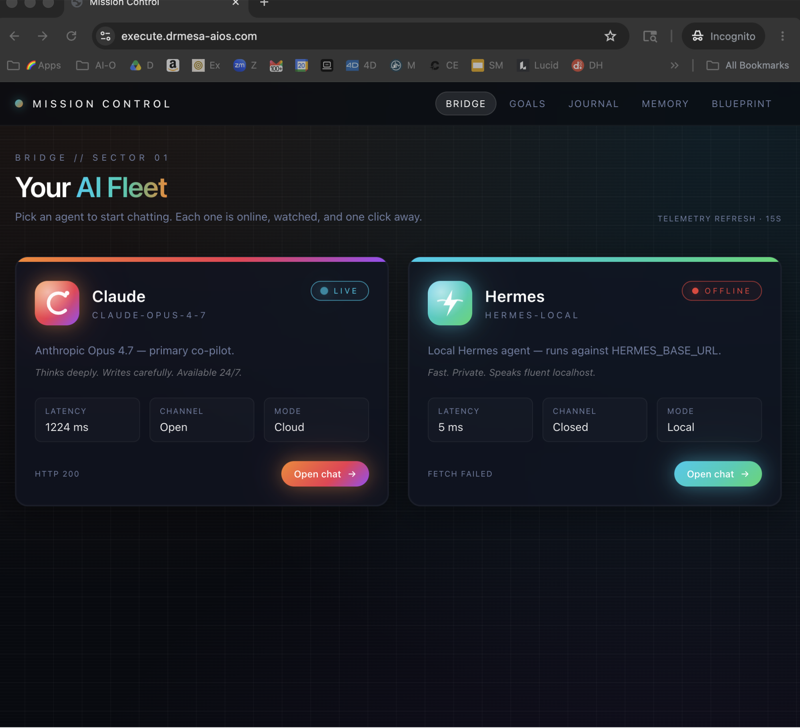
I covered the MCP-server-as-orchestration angle in my Hermes agent mission control post — that's the operational view of running Hermes at the centre.
Fallback Provider Chains — Production Reliability
This one is simple but matters a lot if you run real production agents.
What happens when your AI provider goes down?
Pre-v0.6 — your agent stops. Workflow breaks. You scramble.
V0.6 — Hermes has a fallback chain built in.
If OpenAI goes down, switch to OpenRouter.
If that goes down, fall back to a local model.
Automatic.
No manual fix.
For automated workflows — scheduled reports, content pipelines, member support — this is the difference between a system that works and one that breaks at the worst moment.
You configure the chain once in your config file.
Hermes handles the rest.
Set it and forget it.
I went deeper on production reliability in my Hermes vs OpenClaw breakdown — fallback chains are one of the bigger differentiators.
The Self-Improving Agent Loop (Stronger In v0.6)
Hermes already had a self-improving loop.
V0.6 made it stronger.
Every time your agent completes a task, it stores what it did, builds skills, learns what works.
Searches past conversations to get better context.
Open loop most people miss — they're using it for one-off tasks.
Power users use it to build an agent that knows their entire business over time.
Every brief, every workflow, every piece of content, every community update — stored and referenced.
Your agent doesn't start fresh.
Already has full context.
Already knows your audience.
Already knows your tone.
Every task makes it better at the next one.
That's the real power of v0.6 — it's not a smarter agent, it's an agent that becomes an expert on YOUR specific business.
Sub-Agents And Parallel Execution
Your main agent can now spawn smaller agents to handle tasks at the same time.
Not task one then task two then task three.
Splits the work.
Multiple agents handle multiple things simultaneously.
Complex pipelines finish faster.
Think of it like a manager that delegates to a team instead of doing everything alone.
For content teams, automation businesses, or anyone managing multiple workflows — this is how you scale without hiring more people.
🔥 Want my multi-agent v0.6 deployment template? Inside the AI Profit Boardroom I've documented the multi-profile setup I run — research profile, content profile, ops profile, support profile. Plus the sub-agent prompts that actually parallelise well. 3,000+ members building production AI stacks. Click below. → Get the v0.6 deployment template
New Platform Integrations In v0.6
A few platform integrations worth knowing about:
Feishu (Lark) and WeCom — massive for Chinese enterprise teams. Both have full gateway adapters. Message cards, group chat, image attachments, callbacks — full feature set.
Slack multi-workspace — pre-v0.6, one Hermes gateway = one Slack workspace. Now connect a single gateway to multiple workspaces using an OAuth token file. Each workspace gets its own bot token resolved dynamically.
Telegram webhook mode — flips the connection from polling to push. Faster, cleaner, better for production.
Exa search backend — alternative to Firecrawl and DuckDuckGo. More options for web search inside your agent.
For SEO-flavoured automation, my Claude Code AI SEO post shows how the search-backend choice changes downstream — pairs naturally with the Exa addition.
OpenClaw Migration In v0.6
If you've been running OpenClaw, switching has historically meant manually migrating settings, memories, API keys.
V0.6 expanded the OpenClaw migration significantly.
Now covers:
- Sessions
- Cron jobs
- Memory
- Settings
- API keys
- Skills
The migration tool has a dry-run option so you can see exactly what would be moved before committing.
During first-time setup, Hermes auto-detects if you have OpenClaw installed and offers to migrate before you even configure anything.
That's a smooth path for anyone sitting on the fence about switching.
Run hermes claw migrate --dry-run first, review what'll be moved, then run it for real.
What v0.6 Means For Your Workflows
Multiple agents in parallel.
Existing tools plugged in via MCP.
Auto-failover when providers go down.
Slack across all your workspaces.
If you've been waiting for Hermes to mature enough to be worth your time — that time is now.
The version 1.0 isn't out yet (this is still v0.6) but the architecture is already production-ready for serious automation work.
I'd rather be on a v0.6 of a tool that's improving rapidly than v3.0 of a tool that's stagnant.
Hermes v0.6 FAQ
Do I need to upgrade if I'm on v0.5?
Yes — hermes update runs the upgrade. Multi-agent profiles alone justify the upgrade.
Will my existing memory and skills carry over?
Yes — v0.6 reads existing v0.5 data structures.
Can I run profiles on different model providers?
Yes — that's actually one of the stronger use cases. Claude profile + GPT profile + local profile, all on one machine.
How many profiles can I run?
No hard limit. Practically — until you run out of RAM. Most people run 3-5.
Does MCP server mode require any extra setup?
Run hermes mcp serve and configure your MCP client to connect to it. About 5 minutes total.
What about fallback chains — can I prioritise by cost?
Yes — order the chain however you want. Cheapest first then expensive backup is a common pattern.
Related Reading
- Paperclip Hermes agent — orchestration layer
- Hermes agent mission control — operational view
- Hermes vs OpenClaw breakdown
Final Take
V0.6 isn't a feature release.
It's an architecture release.
Multi-agent profiles, MCP server mode, fallback chains — these are infrastructure pieces.
If you build on them now, you're early.
If you wait until v1.0, you're average.
This Hermes AI course module is the bet on early.
Take it.
🔥 Ready to deploy Hermes v0.6 across your workflows? Get a FREE AI Course + Community + 1,000 AI Agents 👉 join here. Or grab the full v0.6 deployment playbook inside the AI Profit Boardroom.
Learn how I make these videos 👉 aiprofitboardroom.com
Video notes + links to the tools 👉 skool.com/ai-profit-lab-7462
This hermes ai course v0.6 module is the early-mover edge — go and ship a multi-agent profile tonight.