Working out how to install Agentic OS does not have to mean a weekend of wiring. An agentic OS is an AI agent plus the operating system around it — memory, skills, a dashboard and orchestration — and there are two honest routes to getting one running: install a ready-made package, or assemble the parts yourself. This guide covers what you need first, the steps for both routes, and how to fix the usual snags.
📺 Watch: LIVE: Building Agentic Operating Systems with Claude
🔥 Get the Agent OS as a free bonus: AI Profit Boardroom members get the full Agent OS zip, prompt libraries, daily tutorials and weekly live coaching calls. → Get inside
What You Need Before Installing an Agentic OS
Before you install anything, get these basics in place:
- A machine that can run it — a reasonably modern laptop is fine to start; more RAM and a GPU help if you run larger local models.
- An agent engine — either a frontier model via API, or a free local model through Ollama.
- A memory folder — an Obsidian vault or similar to act as shared memory.
- The tools you want connected — whatever your workflows need, ready to wire in through MCP or direct integrations.
How To Install an Agentic OS, Step by Step
- Set up your model. Install Ollama and pull a local model, or add your API key for a frontier model. Confirm the agent can respond before going further.
- Create the memory layer. Set up your Obsidian vault with folders for notes, entities and projects, so the agent has somewhere to read and write context.
- Install the agent and skills. Put the agent in place and load its skills — the reusable capabilities it will call for your workflows.
- Connect your tools. Wire in the tools you need through MCP so the agent can take real actions.
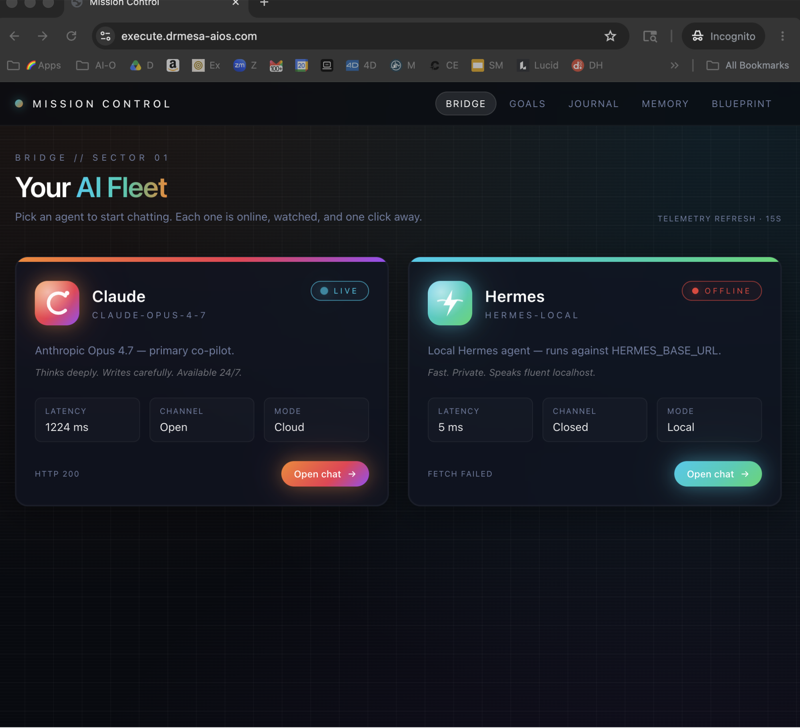
- Add the control center. Install the dashboard so you can launch missions and watch agents work in one place.
- Run a test mission. Give it one small, clear goal end to end. If it plans, acts and saves the result, your agentic OS is installed and working.
The Fast Route: A Ready-Made Install
If you would rather not assemble the parts, the fastest way to install an agentic OS is a ready-made package: download a zip that already contains the agent, the skills, the memory setup and the control center, follow a short video walkthrough, and run it. That takes the install from a multi-day project to an afternoon, and it is how most people who are not developers get a full system running.
If you want the Agentic OS installed the fast way, check out the AI Profit Boardroom — download the ready-made install zip with a video walkthrough, and get weekly coaching to set it up. → Get the install zip here
Troubleshooting Common Install Problems
- The model will not load. Check you have enough RAM for the model size, and start with a smaller local model before scaling up.
- The agent runs but forgets context. Your memory layer is probably not connected — confirm the vault path is set and the agent can read and write to it.
- Tools do not fire. Re-check your MCP or integration setup; the agent can only act on tools it can actually reach.
- It works in the terminal but is hard to manage. Add the control center dashboard so you can see and steer the work.
📺 Watch: NEW Claude 5 + Agentic Operating System!
Hardware: What You Actually Need
You do not need a server to install an agentic OS. What you need scales with the models you want to run locally — if you lean on API models, even a modest laptop is fine.
| Tier | Rough spec | What it unlocks |
|---|---|---|
| Entry | Modern laptop, 8–16GB RAM | API models + small local models; the full OS, control center and memory |
| Recommended | 16–32GB RAM, a decent GPU | Comfortable mid-size local models, faster multi-agent runs |
| Power | 32GB+ RAM, strong GPU | Larger local models fully offline, heavy parallel missions |
The honest rule: start on what you have. You can run the whole system on an entry machine using API or small local models, and upgrade hardware later only if you decide to run bigger models fully offline.
Windows, Mac or Linux?
An agentic OS installs on all three. On Mac and Linux the terminal steps tend to be smoothest. On Windows, most people run it through WSL2 (a Linux layer inside Windows) for the cleanest experience, though native setups work too. Whichever you use, the components are the same — model, memory, skills, tools and a control center — only a few install commands differ, which is another reason a ready-made package with a walkthrough saves time.
📺 Watch: Stop Using Claude Without an Agentic OS!
Your First 30 Minutes After Installing
Installing the software is only half the job — the other half is making it yours. Spend your first half hour like this and the system will feel useful immediately rather than empty:
- Seed the memory. Drop in a few notes about your business, your voice and your goals. This is what stops every output sounding generic, and it takes five minutes.
- Run one tiny mission. Give it something small and safe, like "summarise these three notes into a plan." Confirm it plans, acts and saves the result.
- Check the control center. Watch the run in the dashboard so you know where status, logs and outputs live.
- Add one real skill. Pick the single task you repeat most — drafting, research, reporting — and set it up as a skill so the agent has a proven capability to call.
- Save the mission. Once a mission works, save it so you can replay it instead of rebuilding it.
By the end of that half hour you will have a working agentic OS that already knows a little about you and has done one real job. From there you grow it one skill and one agent at a time, rather than trying to configure everything up front.
A Common Question: Do I Install Or Just Subscribe?
Some agentic systems are cloud services you log into; a personal agentic OS is something you install and own, running on your machine and your accounts. Owning it means your data and memory stay with you and you are not tied to one provider. The trade-off is that you do the install — which is exactly the friction a ready-made package with a video walkthrough removes.
Frequently Asked Questions
Is installing an agentic OS free?
The self-assembled route can be almost free using local models and open tools — the main cost is your time. A ready-made package trades a fee for saving you the setup work.
Do I need coding skills?
For the DIY route, some comfort with the terminal helps. A ready-made install is designed so non-developers can get running with a video and support.
What can I do once it is installed?
Run missions: research, content, outreach, publishing and more — with multiple agents working together and everything saved to memory.
The Bottom Line
There are two honest answers to how to install Agentic OS: assemble the parts yourself — model, memory, skills, tools and a control center — or install a ready-made package and be running the same day. Start with one test mission either way, and once it plans, acts and saves on its own, you have a working agentic OS.