The OmniRoute Hermes agent setup is the complete system I run right now: one agent, one local gateway, hundreds of free models behind it, and a total spend of nothing. I've already answered the quick version of this question in my post on the free API for Hermes agent — this page is the deeper walkthrough. Profiles, routing, compression, workflows and memory, all wired together as one operating setup.
📺 Watch: How to Run Hermes Agent FREE Forever!
🔥 Get the Agent OS as a free bonus: AI Profit Boardroom members get the full Agent OS zip, prompt libraries, daily tutorials and weekly live coaching calls. → Get inside
In other words, this isn't "here's a free key". This is me showing you how the whole machine fits together, the way I demonstrated in my video on running Hermes agent free forever.
The OmniRoute Hermes agent system at a glance
The simplest way to hold it in your head: Hermes agent is the hands, and OmniRoute is the brain supply.
Hermes does the actual work — the browsing, the building, the sending. OmniRoute is an open-source gateway that just dropped, and it routes every request across 231+ free providers. I quote both 231 and 237 in the video, because the pool genuinely keeps growing while you're looking at it.
OmniRoute isn't a Hermes-only thing either. You can plug it into pretty much anything — I've done tutorials on Claude Code and Codex, plus a full OpenCode and OmniRoute build. Here, though, it powers Hermes. And because the whole thing lives inside my Agent OS, it stops being a party trick and becomes an operating system: the gateway feeds the agent, the agent runs my workflows, and the memory layer holds it all together.
One profile per model: how I organise the brains
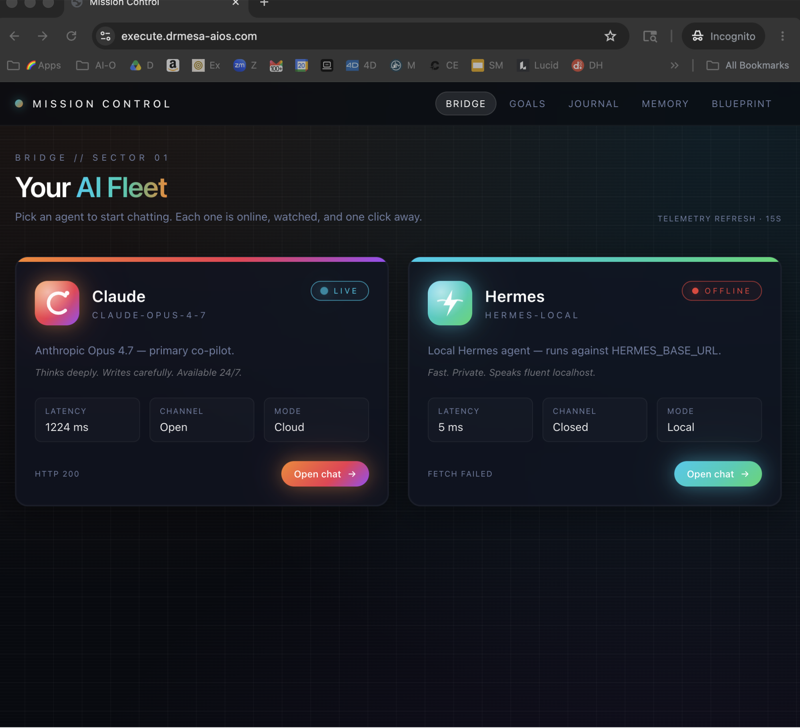
The backbone of my setup is embarrassingly simple: a separate Hermes agent profile for every API and model I use. In the dashboard it's Manage → Profiles, and sitting in that list is the OmniRoute profile, routed through the local gateway on my machine.
That one habit unlocks four things:
- Separate conversation histories. Each profile keeps its own history, so experiments never bleed into each other.
- Side-by-side testing. I can hand two models the identical brief and compare results honestly — this is literally how my Goldie Bench comparisons run.
- Two agents at once. I can run two Hermes agents at the same time on different brains — one grinding through research while another builds.
- New model, same day. When a new model drops, it gets plugged in as a fresh profile the day it lands. No migration, no ceremony.
Most people treat their agent's model like a marriage. I treat it like a squad rotation.
If you want this running without wiring each profile yourself, the AI Profit Boardroom ships the Agent OS with the OmniRoute profile already wired in. → Get the pre-wired Agent OS
The routing chain, step by step
Here's my post office analogy. OmniRoute is a small program on your computer — a gateway that knows how to reach every AI provider, the way a post office knows how to reach every address. Instead of wiring Hermes to OpenAI or Anthropic directly, you wire it to the post office.
- Hermes sends the request to OmniRoute.
- OmniRoute reads it and compresses it.
- It picks the right provider from the pool and routes the request.
- The model answers.
- The answer travels back through the gateway to Hermes.
The part I love: Hermes doesn't know the difference. As far as the agent is concerned, it's talking to one endpoint that always answers. All the clever stuff happens in the middle.
📺 Watch: How to Run Hermes Agent for FREE
Three things that happen automatically
1. Compression: RTK in, Caveman out
On the way in, RTK strips repetition and duplicated fluff from the request. On the way out, Caveman makes the output blunt and brief — genuine caveman-speak. Between them, token use drops hard, and that matters more than it sounds: free tiers limit you based on usage, so lighter requests mean the free providers rate-limit you far less.
2. Routing with automatic fallback
OmniRoute spreads requests across the provider pool, and when one provider hits a rate limit, it falls back to another in milliseconds. You don't see an error. You don't restart anything. The agent just keeps working.
3. Model switching in one word
Want a different brain? You switch models in one word. That's the entire procedure — which, combined with the profiles above, means trying a new model costs me about ten seconds of admin.
The free economics
Here's the bit that makes people sit up. Of the providers in that pool, 90 have a free tier, and 11 are free forever — including OpenCode Zen and Pollinations. (OpenCode is the same family I covered in my Hermes and OpenCode integration guide.)
Then, optionally, you can layer OpenRouter on top: 353 more models behind one key, with a free tier included. Add it up and you've got one endpoint, production grade, with free models stacked behind it. If you're wondering which free brain to actually pick, I've ranked them in my guide to the best free AI model for Hermes agent.
📺 Watch: Hermes Agent V0.20 Just Changed AI Agents Forever!
Plugging it into real workflows
This is the heart of the page, and the reason I keep saying system rather than trick. Because the OmniRoute Hermes agent profile lives inside the Agent OS, it plugs straight into the custom workflows I already run.
Take my lead-generation workflow: it finds leads, sends the emails and manages the inbox. That entire workflow could run on the OmniRoute model directly — same steps, same automations, zero API bill. The workflow doesn't care which brain executes it, so pointing it at free models is a one-line decision, not a rebuild.
Memory: swap the brain, keep the context
The other half of the system story is memory. The moment I switch APIs, the agent recalls full context — projects, preferences, history, all of it — because memory lives in the OS, not the model.
That design decision is what makes the rotation habit viable. If memory sat inside each model's conversation, every swap would lobotomise the agent. Because it sits in the Agent OS layer, swapping brains doesn't reset the agent. New model, same agent.
Old way vs new way
Here's what the OmniRoute Hermes agent setup replaces:
| Area | Old way | New way |
|---|---|---|
| Providers | One provider, one key, one model | 237 providers behind one local endpoint |
| Tokens | Heavy token use on every request | Compressed in (RTK) and out (Caveman) |
| Outages | Provider goes down, agent stops | Automatic switching in milliseconds — and the local gateway itself never goes down or limits you |
| Choice | A handful of models | Free models running in the background, switchable in one word |
What it actually built — and my honest verdict
Demos matter, so in the video I had it code a landing page locally, then opened the result with one terminal command. It worked: smooth, nice-looking, and free.
My honest verdict, from comparing outputs side by side, Goldie Bench style: I wouldn't say this is Fable 5 level, but it can build stuff. That's the fair framing. You're not getting the frontier experience — you're getting a capable free brain that ships real pages while costing you nothing.
Getting it set up
The setup is genuinely non-technical: a couple of terminal commands, copied from the current instructions on the OmniRoute GitHub page. Those commands change as the project updates, which is why I keep the literal steps in one maintained place — my OmniRoute install guide walks it through step by step.
And if you haven't got Hermes running at all yet, start with how to use Hermes agent for free first, then come back and bolt the gateway on.
OmniRoute Hermes agent FAQs
Is this setup actually free?
Yes — that's the point. Ninety providers in the pool have a free tier, 11 are free forever, and the compression keeps you under free-tier rate limits far longer. OpenRouter's extra 353 models are optional and include a free tier too. I run this whole system without paying for the models.
Do I need to be technical to install it?
No. It's a couple of terminal commands from the official instructions, and the routing, compression and fallback all happen automatically once it's running. If you can copy and paste, you can do this.
What happens to my agent's memory when I switch models?
Nothing — and that's the feature. Memory lives in the Agent OS, not inside any one model, so the agent recalls full context the moment you swap APIs. Different brain, same agent, same history.
Can I use OmniRoute with agents other than Hermes?
Yes. It's a general gateway — I've plugged it into Claude Code, Codex and OpenCode as well. If you're weighing up where it fits in a coding stack, my OpenCode vs OmniRoute breakdown covers that decision.
How is this different from just grabbing one free API key?
One key gives you one provider — and when it rate-limits or goes down, your agent stops. The gateway gives you the whole pool with automatic fallback, compression to stretch the free tiers, and one-word model switching, plus profiles and memory when you run it inside the OS. One is a key. This is a system.
My verdict
The OmniRoute Hermes agent system is the best answer I've found to the two things that kill agent setups: cost and fragility. Running Hermes on OmniRoute means the brain supply is free, plural and self-healing — and because the profiles, workflows and memory live in the Agent OS, swapping models becomes a detail rather than a decision. It won't out-build the frontier models, but it builds real things for nothing, and it never leaves my agent standing still.
If you want an agent that runs free forever and never resets on you, check out the AI Profit Boardroom — inside you get the full Agent OS with the OmniRoute profiles, the workflow library and the memory system, plus daily tutorials, weekly live coaching calls and me answering your questions personally. → Set up your OmniRoute profile with us