One keyword goes in. Five genuinely different articles come out, live on five separate websites, often the same day. That is my SEO GEO Claude skill at work — the system from my video "This Claude AI SEO Skill Ranks #1 FAST!" — and this page is the build: the pathway inside the skill file, plus the flywheel around it.
📺 Watch: This Claude AI SEO Skill Ranks #1 FAST!
🔥 Get the Agent OS as a free bonus: AI Profit Boardroom members get the full Agent OS zip, prompt libraries, daily tutorials and weekly live coaching calls. → Get inside
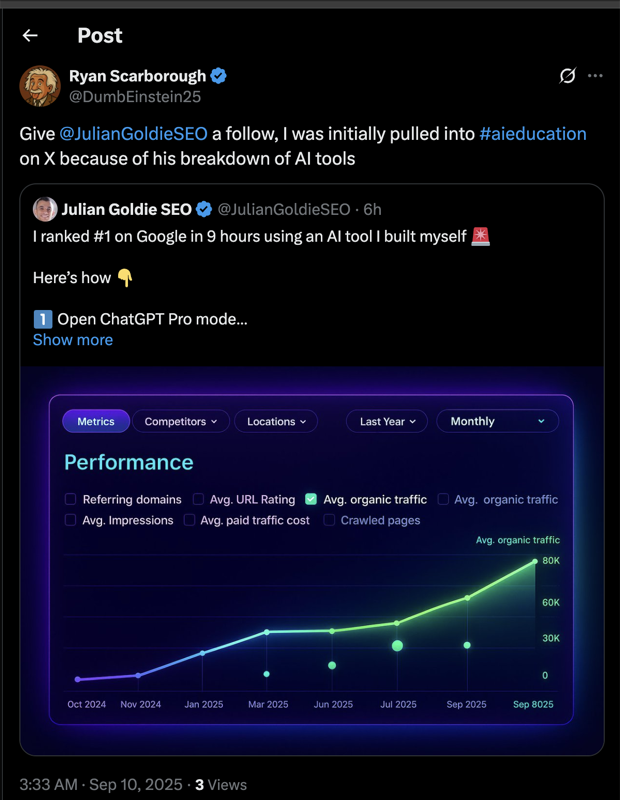
Results first, because they are the whole argument. Across the five sites running this system, one went from 0 to 305 clicks a day, another from 0 to 105, a third from 0 to 34 — free traffic from Google and from AI engines, no ads anywhere. My Claude AI SEO skill guide is the plain-English overview; this page goes under the bonnet.
The Factory: One Keyword and One Case Study In, Five Articles Out
I hand the skill a keyword and a case study, and it hands back five articles that could have been written by five different people — their own titles, their own videos, their own FAQs, their own opening structures, their own examples — each published to a different site. Not five copies with the synonyms shuffled. Five separate answers to the same question.
I call it a content factory with manual quality control bolted on. The machine does the repetitive work; I stay in the loop as inspector, reading what ships and feeding corrections back in. Automation gives you volume; human judgement keeps you rankable.
The Case Study Rule: The Heart of the System
One rule outranks everything else in the file: every fact in every article comes from my real experience or the references I supply. The AI never invents. The 0-to-305 chart can appear in all five articles, told five different ways — but none may conjure a statistic, a client or a result that does not exist.
That is information gain — saying something the other ten results cannot — and it is what separates ranking content from the generic fluff Google ignores. Anyone can publish "AI is changing SEO". Only I can publish what actually happened to my own sites, and that specificity is the moat.
If you would rather install this than build it, the AI Profit Boardroom ships my exact skill file with the full SEO system around it. → Get the skill file
Inside the SEO GEO Claude Skill: The 13-Step Pathway
The skill itself is a markdown file with a 13-step pathway written into it, walked identically on batch one and batch fifty. Here is the pipeline, grouped into the stages that matter.
Intake and planning
The pathway opens with intake: the keyword and the case study become the single source of truth for the batch, and nothing gets drafted that does not trace back to them. Then the skill plans the formatting against my guidelines before writing a word — like briefing a writer before they touch the keyboard.
Headlines: five formulas, keyword front-loaded
Titles come next, and this is where the five-site split begins. The skill writes five optimised headlines on different formulas across the network — a curiosity gap on one site, hard numbers and results on another, a personal story with a bold claim, a straight question — with the keyword front-loaded in every single one.
Writing and formatting
Then the heavy lifting: five unique articles of 2,000 to 3,000 words each, written in my voice, with every sentence on its own line. That choice is deliberate — short lines are effortless for readers to scan and for AI engines to parse. Tables, proper headings and clean structure finish the job. The writing model is whichever one currently tops Goldie Bench, my own testing board.
The conversion layer
Traffic is a vanity metric until it converts, so the skill builds the money layer into every page: a benefit-led opening that earns the read, a call to action in the first third where people actually see it, an author bio for trust, and exit-intent capture for readers on their way out. This layer is what turns clicks into subscribers and sales.
Links woven in
Next, internal and external links get woven through each article. Internal links make crawling and indexing easier and power up the sister pages around them, external references add weight, and occasionally the articles cross-reference the other sites in the network. Connective tissue, not link spam.
Deployment: five sites in parallel
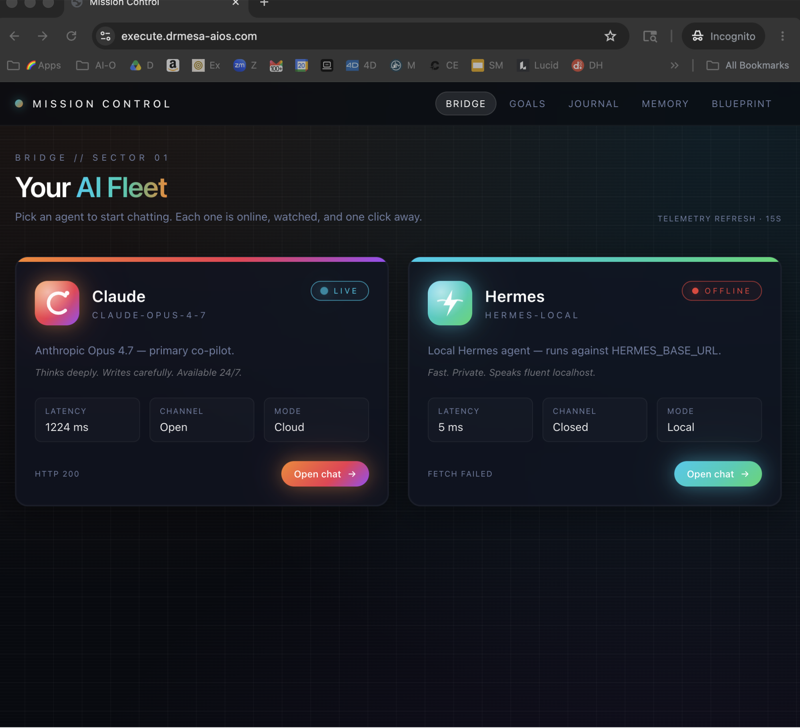
Then everything ships at once. WordPress sites deploy through a login or application token, Netlify sites deploy through an access token, and the skill hands the finished batch to my Agent OS — the agentic operating system that runs my business — which pushes all five live in parallel — no pasting into editors, no lost afternoons.
Indexing the same hour
Most people skip this step. The moment the pages are live, the skill triggers indexing through the Indexceptional API — telling Google the pages exist now, rather than waiting weeks for a crawl to stumble across them. Speed to index is half the reason those charts bend upward so quickly.
Self-improvement at the end of every batch
The pathway closes with my favourite part. The skill reviews what worked across the batch and proposes updates to its own instructions — sharper headline patterns, better formatting calls, whatever the evidence supports. It gets better every batch without being prompted, so today's factory is measurably sharper than the one I started with.
The Flywheel: Search Console Feeds the Machine
The pathway handles one keyword. The flywheel decides which keyword comes next, and this is where the system stops being a tool and starts compounding. Keyword research pulls straight from Google Search Console through the API, hunting for queries where my sites already earn impressions but no clicks — gift-wrapped gaps: Google is already showing the sites, but there is no dedicated page to click.
So the loop spins: more content brings more rankings, more rankings bring more impression data, more data reveals more keywords, and those keywords feed the next batch. It is the same thinking as my agentic SEO skill taken to its logical conclusion — the machine finds its own work.
📺 Watch: 11 Claude Skills to 10X Your Marketing
The GEO Half: Why the Same Pages Win AI Citations
The GEO in SEO GEO Claude skill is not decoration. The same pipeline ranks inside AI engines as well as Google — no separate workflow — because the three things AI engines cite are already baked in. Sentence-per-line formatting makes answers easy to lift. Case-study specificity gives engines first-hand facts worth quoting. And the multi-site presence puts the same verifiable story on five domains, which reads as corroboration rather than coincidence.
I have gone deeper on the citation side elsewhere: the 4-A framework is in my Claude skill for SEO and GEO breakdown, and the pure citation playbook — how AI engines choose what to quote — lives in my GEO Claude skill guide. None of it is hypothetical — watching my own pages get quoted inside AI answers is how my Grok SEO system came about.
📺 Watch: Claude Code AI SEO: How to Rank #1 with Claude Code
Build Your Own or Use Mine
Here is the part that surprises people: a Claude skill is just a markdown file. Plain-text instructions that Claude loads and follows — teach the method once and it runs forever, no code, no plugins, no bloated SaaS subscription. Everything on this page is the pathway, so you can open a blank file tonight and write your own version.
Mine ships inside the AI Profit Boardroom if you would rather start from a working file than a blank one. If you are weighing up approaches, my best SEO skill for Claude roundup ranks the options — and the same skill-file idea powers my Hermes SEO skills on a completely different agent, proof the concept is bigger than any one tool.
The Pipeline at a Glance
| Stage | What happens | Why it matters |
|---|---|---|
| Intake | One keyword plus one real case study go in | A single source of truth; nothing invented |
| Planning | Formatting planned against my guidelines | Structure decided before a word is drafted |
| Headlines | Five formulas — curiosity, numbers, story, question — keyword first | Five different doors into the same topic |
| Writing | Five unique 2,000–3,000-word articles, sentence per line | Scannable for readers and for AI engines |
| Conversion | Benefit-led opening, CTA in the first third, bio, exit-intent | Turns traffic into subscribers and sales |
| Links | Internal and external links woven through | Faster crawling; sister pages get stronger |
| Deployment | All five sites ship in parallel via WordPress and Netlify tokens | Zero manual uploading |
| Indexing | Indexceptional API pings Google the same hour | Pages found in hours, not weeks |
| Self-improvement | Skill reviews the batch and updates its own instructions | The factory sharpens itself over time |
SEO GEO Claude Skill FAQs
What is the SEO GEO Claude skill?
A markdown skill file for Claude that turns one keyword and one case study into five genuinely different articles, deploys them to five websites, triggers indexing the same hour and then reviews its own performance. One input, five ranking assets, built for Google and AI engines at the same time.
Does AI-written content actually rank?
Bad AI content does not — generic fluff gets ignored whoever wrote it. Case-study content does, because it carries facts nobody else has. The charts are my evidence: 0 to 305 clicks a day, 0 to 105, 0 to 34, all from this exact pipeline with real experience at the centre.
How many articles come from one keyword?
Five — one per site, each genuinely different: separate headline formulas, openings, examples and FAQs, all drawing on the same case study. One research effort becomes five chances to rank.
Does it work on WordPress and Netlify?
Both, in the same batch. WordPress sites deploy through a login or application token, Netlify sites through an access token — deployment is just another step of the pathway, not a separate job for you.
Does the skill really improve itself?
Yes. The final step of every batch is a review: the skill studies what worked and proposes edits to its own instruction file. I approve the good ones, and the next batch runs on sharper instructions. It is the closest thing to compound interest I have found in content.
My Verdict
Most people write one article at a time and hope. This pipeline turns the same effort into five ranking assets, indexed within the hour, feeding a flywheel that finds its own keywords while the skill quietly upgrades itself. If you are starting from zero, my free SEO course covers the foundations — then build the pathway above, or grab mine and skip straight to publishing. Either way, stop buying one lottery ticket at a time.
If you want the factory instead of the blueprint, check out the AI Profit Boardroom — inside you get my exact skill file, the Agent OS it runs on, the AI SEO playbooks, four weekly coaching calls, daily tutorials and 3,700+ business owners scaling alongside you. → Run the factory