9Router vs OmniRoute isn't a fight I settle by crowning one router — I run both, sitting in the same dropdown, and flip to the other the second one hits a limit. They attack the free-AI-coding problem from opposite ends, though: 9Router routes your requests through the AI subscriptions you already pay for, topped up with free tiers, while OmniRoute skips subscriptions entirely and hands you a pool of free models behind a single key. That difference decides which one you should install first, so below I'll lay out what each router actually does, the six differences that matter, and exactly how I run the pair together every day.
📺 Watch: 9Router: New FREE Unlimited AI Coder!
🔥 Get the Agent OS as a free bonus: AI Profit Boardroom members get the full Agent OS zip, prompt libraries, daily tutorials and weekly live coaching calls. → Get inside
What 9Router and OmniRoute actually are
9Router is a local, OpenAI-compatible proxy that sits on localhost port 20128 and routes every request to the best available provider. Its signature move is wiring into OAuth sessions you already have — Claude, Codex, GitHub Copilot, Cursor and Antigravity are the five subscription providers the repo documents — alongside three free-tier providers (Kiro, OpenCode Free and Vertex AI) and more than twenty API-key providers. It's MIT-licensed and the router itself never charges you a penny; the source is all there at decolua/9router on GitHub.
OmniRoute comes at the same problem from the free end. It's a free, open-source router built around a pool of free models — one key unlocks the whole pool — and it leans hard on compression: RTK shrinks what goes into the model and Caveman shrinks what comes back out, so every request spends fewer tokens and you hit free-tier rate limits far less often. Fallback between models happens in milliseconds, which keeps the whole thing feeling smooth rather than free-tier flaky.
9Router vs OmniRoute: the six differences that decide it
1. Access model: route what you own vs one free-pool key
This is the philosophical split. 9Router assumes you already pay for something — a Claude plan, Copilot, Cursor — and puts a local proxy in front of those OAuth sessions so any OpenAI-compatible tool can spend capacity you've already bought. OmniRoute assumes you pay for nothing: one key, one pool of free models, no subscription anywhere in the chain. Neither approach is wrong; they're aimed at different wallets.
2. Fallback design: three tiers vs milliseconds
9Router documents a Smart 3-Tier Fallback — Subscription first, then Cheap, then Free — auto-switching whenever a quota runs out or a provider errors, with a zero-downtime design so your session doesn't stall. OmniRoute's fallback is flatter but quick: when a free model in the pool taps out, it hops to the next one in milliseconds. 9Router's ladder protects your paid capacity; OmniRoute's hop hides the churn of free tiers.
Want my exact two-router setup instead of piecing it together yourself? I share the full config, the fallback stack and the agents I run behind it inside AI Profit Lab — grab my 9Router and OmniRoute stack here. Prefer to talk it through first? Book a free SEO strategy session and I'll map it to your business.
3. Compression: RTK one way vs RTK plus Caveman both ways
9Router ships the RTK Token Saver, which compresses tool outputs before they're fed back to the model — a documented 20-40% input-token saving, switched on by default. OmniRoute runs a compression pair: RTK shrinks what goes in and Caveman shrinks what comes out. On a free-pool router that double squeeze matters more, because fewer tokens per request is the difference between cruising along and slamming into rate limits every ten minutes.
4. Breadth: the numbers each side actually claims
Attribution matters here, so I'll keep it straight. The 9Router repo lists 100+ models; my own install counted 573+ models across 40+ providers once everything was connected. OmniRoute's pool is smaller on its own, but bolt OpenRouter onto it — the exact route from my OpenCode and OmniRoute guide — and 353 more models sit behind that same single key, with a free tier of its own. Both routers end up broad; they just get there differently.
5. Setup surface: localhost dashboard vs a one-guide install
9Router gives you a dashboard on localhost port 20128 where you connect providers and watch requests route — my how to use 9Router walkthrough covers it click by click. OmniRoute's setup is a short, boring install I've written up in my OmniRoute install guide. Neither needs a server, a card, or anything beyond the laptop you're on.
6. Honesty about free tiers: read the warnings
I respect that the 9Router README warns you itself: the Kiro free tier is capped at 50 credits a month, OpenCode Free's model list fluctuates, and several free tiers — iFlow, Qwen Code, Gemini CLI — were discontinued in 2026. That candour applies to this whole category, OmniRoute included: free pools shift under your feet because providers change their terms, not because the routers fail. The routers themselves never charge; it's the weather around them that changes.
📺 Watch: Omniroute + OpenCode: 100% FREE AI Coding Setup!
When 9Router wins
9Router wins the moment you already pay for one AI coding subscription. If Claude Code, GitHub Copilot or Cursor is on your card each month, routing through what you own is the obvious play: the 3-tier fallback spends your paid capacity first, drops to cheap API keys second and free tiers last, so you squeeze full value from the subscription before touching anything flakier. That single design decision is why 9Router is my default recommendation for anyone who codes for a living.
When OmniRoute wins
OmniRoute wins when you have no subscriptions at all and no intention of starting one. It's the pure-free path: one key, a pool of free models, and compression working in both directions to stretch every rate limit you meet. If you're testing whether agentic coding is even for you — before spending a pound — OmniRoute is the cleaner starting line.
📺 Watch: OmniRoute: New FREE Unlimited AI Coder!
My verdict: run both in one dropdown
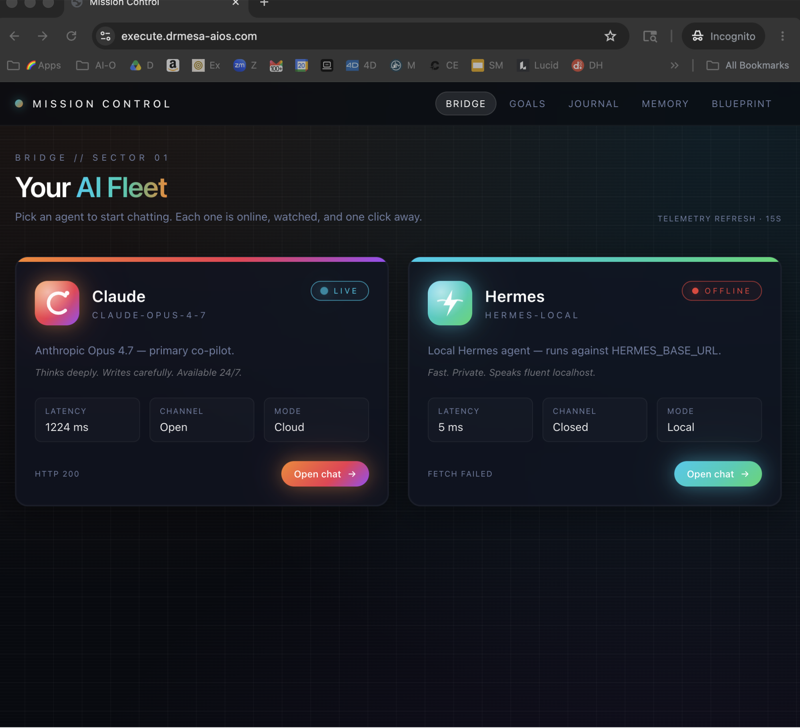
My actual answer to the 9Router vs OmniRoute question is sitting in my Agent OS right now: the free AI coder tab has a dropdown with both routers in it. Both are open source, both are free, so there's no budget reason to choose. I keep two because redundancy is boring and boring wins — if one gets rate-limited or a subscription runs dry mid-task, I flip to the other and keep shipping. And before I trust either router on anything that matters, I push the same jobs through both on Goldie Bench and compare what comes back.
9Router and OmniRoute at a glance
| Dimension | 9Router | OmniRoute |
|---|---|---|
| What it is | Local OpenAI-compatible proxy on localhost port 20128 | Free, open-source router around a pool of free models |
| Access model | OAuth subscriptions (Claude, Codex, GitHub Copilot, Cursor, Antigravity) plus 3 free-tier and 20+ API-key providers | One key unlocks the free pool |
| Fallback | Smart 3-Tier: Subscription, then Cheap, then Free; auto-switching, zero-downtime design | Millisecond fallback between pool models |
| Compression | RTK Token Saver on tool outputs, 20-40% input-token savings, on by default | RTK shrinks input, Caveman shrinks output |
| Breadth | Repo lists 100+ models; my install counted 573+ across 40+ providers | Free pool, plus 353 more models via OpenRouter on one key |
| Cost | Free, MIT licence, the router never charges | Free and open source |
| Best for | Anyone already paying for an AI subscription | Pure-free starters with no subscriptions |
9Router vs OmniRoute FAQ
Which is better, 9Router or OmniRoute?
The honest split: 9Router is better if you already pay for any AI subscription, because routing through what you own beats leaving paid capacity idle. OmniRoute is better if you pay for nothing and want the pure free pool, with compression doing the heavy lifting against rate limits. There's no universal winner — your wallet decides.
Can I run 9Router and OmniRoute at the same time?
Yes — that's literally my setup. Both routers live in a dropdown in my free AI coder tab, and I switch whenever one hits a quota, a rate limit or a dry subscription. Two free, open-source routers cost nothing extra to keep installed, and that redundancy is the entire point of the pattern.
Are 9Router and OmniRoute both free?
Both routers are free and open source — 9Router is MIT-licensed and never charges, and OmniRoute is free by design. What varies is the providers behind them: free tiers get capped, fluctuate or get discontinued, and 9Router's own README lists real examples. The router stays free forever; the provider weather changes.
Do 9Router and OmniRoute work with Hermes and Claude Code?
Yes on both counts. 9Router wires straight into your existing Claude OAuth session, which is exactly what makes it useful alongside a Claude Code subscription. OmniRoute pairs with Hermes as an agent backend — I documented that pairing in my OmniRoute and Hermes guide — so either router can sit behind the agents you already run.
Final verdict on 9Router vs OmniRoute
My number one pick for most people is 9Router, for one reason: most people reading this already pay for at least one AI subscription, and routing through what you own — with cheap and free tiers as the safety net underneath — is the highest-value move on the table. If you're starting from pure free, with no subscriptions anywhere, start with OmniRoute and its compressed free pool. And if you're a power user, do what I do: install both, put them in a dropdown, and let redundancy do the worrying for you.
Ready to stop rationing tokens and start shipping? Join AI Profit Lab and copy my two-router dropdown setup — the exact 9Router and OmniRoute stack from this article, plus the agents I run behind it. Or book a free SEO strategy session and we'll plan your setup one to one.