Google Antigravity Teamwork is the multi-agent orchestration framework inside Antigravity that Google updated on 27 August 2026: run the /teamwork-preview command on any paid plan and Antigravity spins up a team of specialised agents that propose, critique and refine each other's work autonomously over hours or days. According to the announcement on the Antigravity blog, the updated framework has already solved seven open problems in mathematics and theoretical computer science, built a cycle-accurate RISC-V CPU simulator that boots an operating system from scratch, and shipped performance optimisations merged into upstream open-source libraries including Eigen and ParlayHash. For those of us running businesses on AI agents, this is the clearest signal yet of where orchestration is heading — and there are lessons in it you can use this week even if you never touch a maths proof.
📺 Watch: Antigravity Teamwork Can Run AI Agents for DAYS
🔥 Get the Agent OS as a free bonus: AI Profit Boardroom members get the full Agent OS zip, prompt libraries, daily tutorials and weekly live coaching calls. → Get inside
📺 Watch: NEW Antigravity Updates are MIND BLOWING!
What Google Antigravity Teamwork Actually Does
Per the announcement, most multi-agent setups fail on hard problems for a very human reason: loosely organised agents agree with each other's early mistakes and build confidently on flawed ideas. Teamwork is built around the opposite behaviour. It organises agents into teams that actively challenge each other's work, look for flaws before building further, and combine the strongest pieces into working solutions. Google describes the common structure of research and engineering problems as generate candidates, stress-test them, and combine the best ideas — and Teamwork makes that loop concrete and configurable while keeping humans in charge of objectives and final acceptance.
The framework pairs with Gemini 3.7 Flash, which the post calls Google's most intelligent model yet, and the whole thing is invoked with a single command: /teamwork-preview. Gemini analyses your prompt and automatically selects the right team structure for the task, so you are not writing orchestration code — you are describing an outcome.
The Five Patterns, Explained for Non-Researchers
Teamwork is not one fixed team. According to the blog post, each distinct configuration is called a pattern — a blueprint defining which agents participate, what roles they serve, and the criteria required for work to move forward. Five specialised patterns ship today, selected automatically based on your task:
- Iterative Coding — for problems that cannot be split up, solved through tight agent-test-refine loops.
- Distributed Coding — for decomposable engineering tasks that fan out across parallel workers with critic review.
- Long Proof — for open-ended mathematics and theoretical computer science, where each candidate is stress-tested before it can advance.
- Self-Verification — depth-first mathematical reasoning with rigorous self-checking at every step.
- Document Review — structured analysis and critique of papers and technical documents.
Two design details stand out. Patterns are specifications rather than executable programs — the orchestration logic is decoupled from the agent descriptions, so a mechanism like an adversarial critique loop can be ported across entirely different domains without modification. And patterns are adaptive at runtime: the framework dynamically decides how many agents to spawn based on the task, and team structure can shift mid-run as the problem reveals itself. Google calls each campaign a living process, not a fixed pipeline.
Want to run your business like a team of agents instead of a to-do list? Inside AI Profit Boardroom I share the Agent OS, the exact multi-agent workflows I sell with, and weekly live coaching calls to build yours — set up your own agent team inside AIPB.
The Results Google Is Claiming
The announcement is unusually concrete about outcomes, so it is worth listing them as stated. In research mathematics and theoretical computer science, Teamwork solved seven open problems — including results in sparse convex optimisation, subspace approximation, provable LLM quantisation, vector embeddings, Prefix-Matrix Factorisations, and Knuth's Cycles Conjecture, verified in Lean — and scored 71 percent on TCSBench, which Google says is the highest score in its internal testing. In systems engineering, it produced a cycle-accurate RISC-V CPU simulator that boots an operating system from scratch. In open source, it contributed performance optimisations merged directly into upstream libraries including Eigen and ParlayHash. Those are Google's own claims from its own blog, and the sensible posture is interested scepticism — but merged upstream commits and Lean-verified proofs are the kind of claims that can be checked, which is precisely why they are worth taking seriously.
What This Means If You Build With Agents
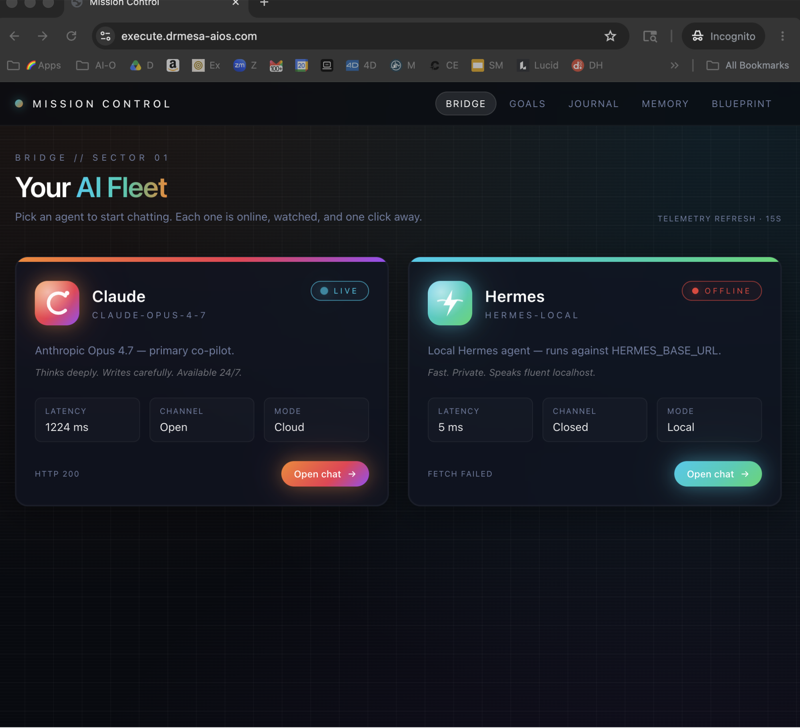
I have been shipping code with Antigravity since the multi-agent workflow first clicked for me — my full walkthrough is in how to vibe code in Antigravity — and Teamwork formalises the thing I was doing manually: making agents check each other instead of trusting one agent's first answer. That principle transfers directly to any stack. In our own Agent OS, the operating system we built for running Hermes agents across my businesses, the highest-value routine is exactly this shape: one agent drafts, another critiques against a checklist, and nothing ships until the critique passes. Google has now demonstrated at research scale that the critique loop is the difference between agents that compound and agents that confidently drift.
The hours-or-days framing matters too. Teamwork campaigns run autonomously over hours or days, with humans setting objectives and accepting the final result. That is a different working relationship with software than a chat window — closer to briefing a contractor than prompting a model. If your current agent use is one prompt, one answer, you are leaving most of the value on the table, and the tooling is now openly designed around the longer loop. I run the same long-loop philosophy on the Hermes side with Hermes plus Antigravity, and for orchestrating parallel work streams day-to-day the Hermes kanban agent covers the same job at small-business scale.
How to Try Google Antigravity Teamwork Today
- Get on a paid Antigravity plan. Per the announcement, Teamwork is available today as /teamwork-preview in Antigravity on all paid plans — it is a preview command, not a separate product.
- Bring a genuinely hard task. Google is explicit that the feature is built for problems that are too large, too uncertain or too open-ended for a single agent loop. Routine tasks do not need it — the post itself says basic multi-agent approaches are often enough for those.
- Describe the outcome, not the process. Pattern selection is automatic: Gemini reads your prompt and picks the team structure. Your leverage is in a clear objective and clear acceptance criteria, which is the same skill that makes every agent stack work.
- Stay in the acceptance seat. The framework keeps humans in charge of objectives and final acceptance. Treat its output like work from a brilliant new hire: verify before you ship.
Is Antigravity Teamwork available on the free plan?
Not per the current announcement: Google states Teamwork is available today as /teamwork-preview in Antigravity on all paid plans, and the blog makes no mention of a free-tier route. If you are not ready to pay, the principle still costs nothing to copy — the drafting-agent-plus-critic-agent loop described below runs on any agent stack you already have, and it is the part of Teamwork that moves the needle for a normal business anyway.
How long does a Teamwork run take?
The announcement's framing is hours or days, not seconds. Teams of agents propose, critique and refine autonomously over long horizons, with the framework deciding how many agents to spawn and how many rounds to run based on the problem. Budget for it the way you would budget a contractor's week, then judge the output against what that time would have cost you in salary or freelance fees.
📺 Watch: This Google Antigravity Setup Changes Everything
My Take: Orchestration Is the Moat Now
The models underneath keep leapfrogging each other, but the pattern in every serious release this month — this one included — is that the value has moved up a layer, to how agents are organised. That is why we spend our time building and testing operating systems for agents rather than chasing each new model, and why Goldie Bench, our own benchmark suite, tests full agent workflows rather than raw model answers; I will be designing a Teamwork-style critique-loop test into the next round of it. Verification-first orchestration beat solo genius in Google's results, and in my experience running agents commercially, it beats it in business workflows too. The tools to copy that principle are already free in your stack — the Hermes MCP server will happily let your agents call each other today.
Start smaller than Google did. Pick one deliverable this week, split it into a drafting agent and a critic agent, and refuse to ship until the critic signs off. That single loop is Teamwork's core idea at one-thousandth the scale, and it will improve your output the first day you run it.
If you want the multi-agent playbook without the research budget, join me inside AI Profit Boardroom — the full Agent OS, done-for-you agent team workflows, daily tutorials and weekly live coaching calls are all inside — build your agent team with us here.