Hermes GPT 6 is a Hermes agent install with a GPT-class model selected as its brain, and this page is the feature-by-feature reference for what that combination gives you.
No opinion piece, no build diary.
Just every feature in the system, one section each, in the order you'll meet them.
I'll flag the honest limits as I go, because a reference that only lists the good bits isn't a reference.
Here's the full system running so you can put pictures to the feature names.
Feature 1 — the model manager
This is the feature that makes the phrase "Hermes GPT 6" mean anything at all.
Hermes ships with a model manager and a dashboard where you pick the brain.
You select the GPT model you have access to, save, and every other feature on this page now runs on that model.
The reason I care about this more than any individual model launch is simple.
When something better comes out, I change one setting instead of rebuilding a system.
If you want the model comparison rather than the mechanism, I covered it in best Hermes agent models.
Feature 2 — voice output through ElevenLabs
Hermes handles the agent work, and ElevenLabs generates the spoken reply.
That's the second of the three parts in my build.
You can switch between voices, so it sounds how you want it to sound rather than how a default TTS engine sounds.
This is the feature that changes how the whole thing feels to use, because reading output and being told the answer are different experiences.
Feature 3 — the wake word
You can say "Jarvis" or "Hermes" and it switches on.
Say the word again and it switches off.
That means you can leave it sitting in the background as a wall-mode voice assistant, ready and waiting.
Or you can ignore the mic entirely and type into it, which I do when I'm on a call.
Feature 4 — auto mode and agent mode
There's a switch between auto and agent mode.
Auto is the lighter conversational path, and agent mode is where it goes off and does multi-step work.
Picking the wrong one is the most common reason a new install feels underwhelming, so check which mode you're in before you blame the model.
Feature 5 — computer use and browser use
I said "Jarvis, open up juliangoldie.com" and it replied "opening Julian Goldie's site now, sir" and opened the website.
Computer use and browser use are built into the system.
That's genuinely powerful in itself, because an agent that can open and read a page can check its own work.
A model without this can only describe what it would do.
🔥 Want the exact setup I used to get these results? Inside the AI Profit Boardroom, I've got a full Hermes agent section with step-by-step video tutorials covering every feature on this page. Plus weekly coaching calls + 2,800+ members building real automations. → Get access here
Feature 6 — the build engine
You ask for a thing and it builds the thing.
I asked for a galaxy I could swirl with my mouse and got back "Built and running, sir" with a working page.
The builds in my gallery right now include a habit tracker, a full website, a Japanese flashcard game and a meditation timer.
It can even create videos.
I don't code, and all of that came out of spoken requests.
Feature 7 — the build gallery
Scroll down in the interface and there's a section showing everything you previously built.
You can open any of them and view them again.
Ask "show me everything I've built" and it pulls the list up for you.
This is the feature that stops your experiments evaporating, and it's the one people underrate until their first good build disappears.
Feature 8 — full conversation history
Every conversation is stored and browsable.
You can scroll the full history of everything you've said to it and everything it said back.
Combined with the build gallery, that gives you a record of both the talking and the doing.
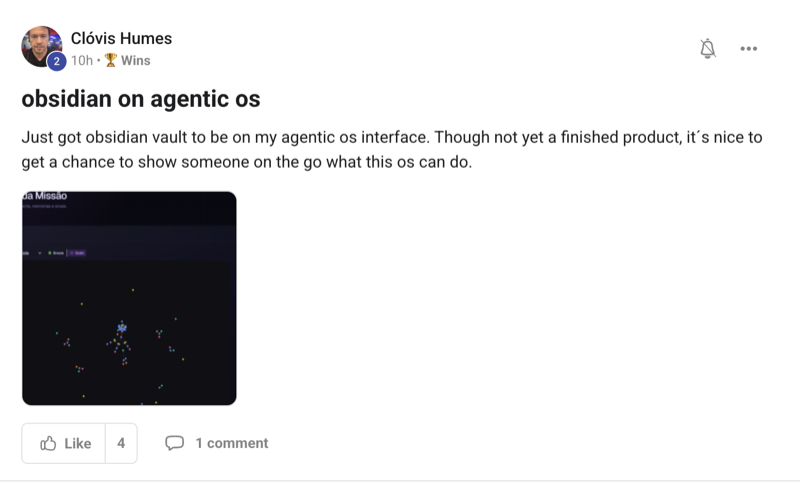
Feature 9 — Obsidian second brain memory
My conversations with Hermes and Hermes Jarvis are linked to my Obsidian memory.
I call it the memory galaxy, and it's my second brain.
Everything I do with Jarvis lands in a log I can return to later.
That's how it answered "what have I been working on this week" with "you've been tinkering with thumbnail work — the thumbnails log shows recent edits there".
It read the log rather than guessing, and that difference is the whole ballgame.
Here's that memory layer built out on its own.
Feature 10 — your agent team view
I say "Jarvis, show me my team" and it pulls up the agents ready inside the system.
That's Claude, the open core agents and Hermes itself, all in one place.
It's a roster, not a decoration, because those are the agents available to take work.
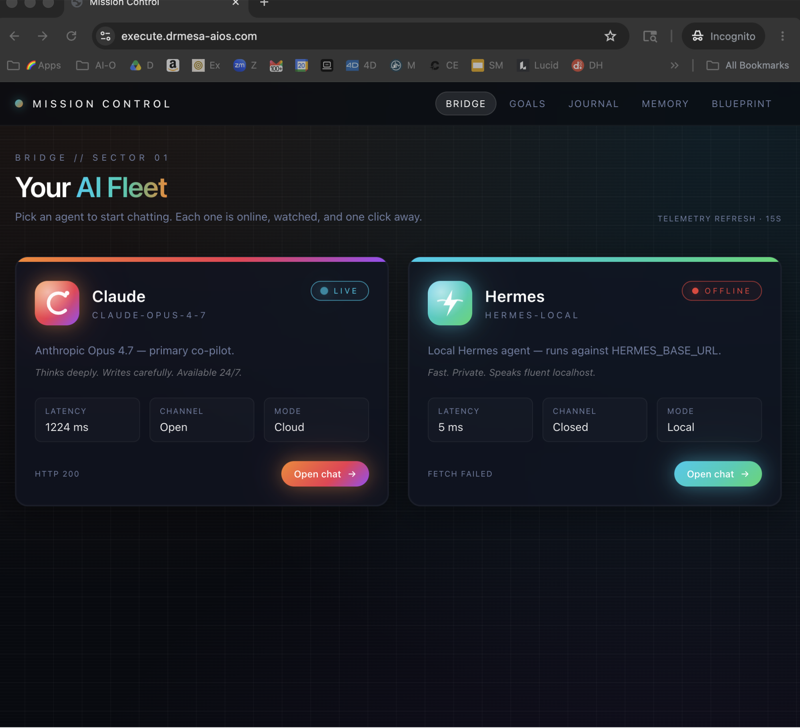
Feature 11 — mission control
There's a mission control view for seeing what's running.
I went through that view properly in Hermes agent mission control if you want the detail.
Feature 12 — paperclip and AI agent teams
Paperclip is built in with AI agent teams.
This is the feature I'd point you at if your goal is output rather than spectacle.
For actually getting stuff done, I think you create a lot more a lot faster with an agent teams setup than with a single voice agent.
The swarm side is covered here.
Feature 13 — agent group chat
There's an agent group chat where Hermes can talk to Claude and Gemini.
Different models argue their way to a better answer than any of them gives alone.
That's one of my favourite features in the whole system.
Feature 14 — goal mode
Goal mode is where you hand over an outcome instead of an instruction.
You state what you want to be true, and it works towards it.
I unpacked how I use it in Hermes agent goals.
Feature 15 — chat mode
If you just want to talk to it inside a chat box, that's there too.
No voice, no agent loop, just a normal conversation with the model you selected.
It's the fallback I use when I want a quick answer rather than a build.
Feature 16 — MCP support
You can link Hermes in general with MCPs.
That's how you extend it past what ships in the box, and it's the reason the feature list on this page will be out of date faster than I can update it.
Feature 17 — the Claude improvement loop
The third part of my build isn't a button in the interface.
It's Claude working in the background on the system itself, adding improvements and fixing what's rough.
Hermes does the agentic work, ElevenLabs does the voice, and Claude does the upgrades.
That's the whole architecture in one line.
Feature comparison at a glance
| Feature | What it gives you | Needs extra setup? |
|---|---|---|
| Model manager | Swap the brain in one click | No |
| Voice + wake word | Hands-free Jarvis mode | Yes, ElevenLabs |
| Computer + browser use | It can open and read pages | No |
| Build engine | Working apps from spoken requests | No |
| Build gallery + history | Nothing you make gets lost | No |
| Obsidian memory | Real recall across weeks | Yes, vault link |
| Agent teams + group chat | Parallel output, model debate | No |
| Goal mode | Outcome-driven work | No |
| MCP support | Any extra tool you need | Yes, per MCP |
What it deliberately doesn't do
It doesn't always work, and I'd rather say that than oversell it.
Sometimes it's not that smooth.
It isn't a finished consumer product, it's an open source system you improve daily.
And for pure implementation work, I'd still pick the agent teams route over the voice route.
The Jarvis build is my favourite party trick with AI, and it's the one I show people first — but I know which one ships more work.
🔥 Want my full Hermes Jarvis + Agent OS setup? The AI Profit Boardroom has the full video tutorial, the install zip with the prompts, and new tutorials added daily. Ask questions and get help in real time from me and 2,800+ members. → Get the setup here
Hermes GPT 6 FAQ
What does the Hermes model manager do?
It's where you pick which model powers the whole system.
Selecting a GPT-class model there is what makes your install a Hermes GPT 6 setup.
Changing it later is one setting, not a rebuild.
Does Hermes have computer use and browser use?
Yes, both are built in.
Ask it to open a site and it opens the site rather than handing you a link.
What is Hermes goal mode?
Goal mode takes an outcome instead of a single instruction.
You describe the end state, and it plans the steps to get there.
Can Hermes talk to Claude and Gemini?
Yes, through the agent group chat.
There's also paperclip with AI agent teams and a mission control view for watching the work.
Does Hermes support MCPs?
Yes.
MCPs are how you add tools and integrations that aren't in the base project.
Is Hermes GPT 6 reliable enough for daily work?
Honestly, it's improving daily rather than finished.
For heads-down execution I'd use the agent teams setup, and for voice-driven building and demos the Jarvis build wins.
About Julian
I'm Julian Goldie — AI entrepreneur, SEO expert, and founder of the AI Profit Boardroom (2,800+ members). I help business owners scale with AI agents, automation, and SEO.
- 400K+ YouTube subscribers
- 7-figure AI agency (Goldie Agency)
- Daily training inside the Boardroom
- Author of multiple AI automation playbooks
→ Get my best AI training inside the AI Profit Boardroom
Also On Our Network
- 🌐 Read on bestaiagentcommunity.com
- 🌐 Read on juliangoldieaiautomation.com
- 🌐 Read on aisuccesslabjuliangoldie.com
- 🌐 Read on aimoneylabjuliangoldie.com
Related reading
- Best Hermes agent models — picking the brain.
- Hermes agent mission control — the view that runs it all.
- Hermes agent swarm — when one agent isn't enough.
Work through these features in order and you'll have a Hermes GPT 6 build that does far more than the model on its own ever could.
📺 Video notes + links to the tools 👉