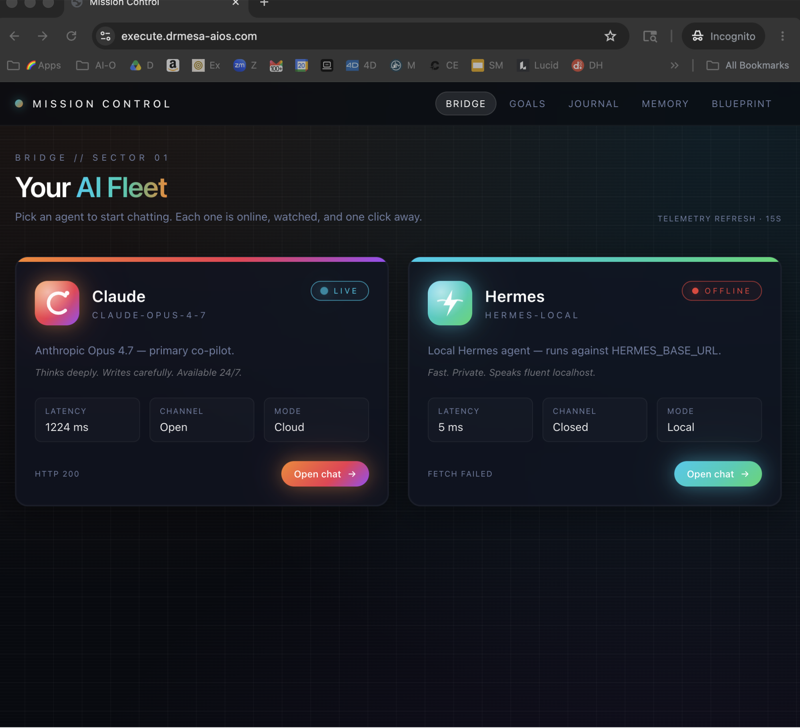
If you want to know how to run Hermes Agent on DeepSeek V4 Flash, you're asking the exact question I asked myself last week.
I searched for a straight answer, and I found a wall of half-finished guides instead.
So I did what I always do when the internet disappoints me: I opened the docs, I broke things, and I wrote down what actually worked.
This is that write-up, in plain English, start to finish.
Here's what you'll get: the two-minute profile setup, the dated 0731 build trap that ate an hour of my life, and what a 1M-context agent-tuned brain really changes when your jobs run long.
The short version is that it works, it's fast, and it costs a fraction of what the big-name frontier models charge.
But the short version never tells you where the bodies are buried.
Let me show you the whole thing.
You Can Run Hermes Agent on DeepSeek V4 Flash in Two Minutes
First, the honest truth about the setup: it's easier than you think.
The entire setup is a profile, and a profile is just a named config that tells Hermes Agent which provider and which model to talk to.
You are not compiling anything, and you are not rebuilding the core install.
You are just telling the agent which brain to use, and the agent does the rest.
Here's the whole two-minute process, exactly as I do it.
What You Need Before You Start
You need a Hermes Agent install that is reasonably up to date.
You need a DeepSeek API key with a little credit on the account.
You need the exact model name, deepseek-v4-flash, because typos here fail silently.
You do not need a powerful computer, because the heavy lifting happens on DeepSeek's servers.
You also need five minutes of peace, and that is genuinely the whole shopping list.
Step 1: Check Your Current Profile
Open a terminal and run the profile command to see where you are right now.
The command takes two seconds, and it tells you which provider and model are live.
If you see the default provider staring back at you, you're in exactly the right place to switch.
Step 2: Create a DeepSeek Profile
Create a new profile and name it something you'll recognise in six months.
I use "deepseek", because I am not clever enough to remember clever names.
The command spins up an empty profile directory in seconds.
That directory lives under your Hermes profiles folder, and it is the only place you need to touch.
Step 3: Point the Profile at DeepSeek V4 Flash
Open the config file inside your new profile and set the provider to DeepSeek.
Set the model to deepseek-v4-flash, and make sure your API key is in place.
The config file is plain text, and the keys are named exactly what they do.
I keep my key in an environment variable rather than in the file, because that keeps it out of any backup that syncs to the cloud.
Save the file, and you are done with the actual setup.
Step 4: Launch and Verify
Launch Hermes Agent with the new profile and ask it a simple question.
If it answers, you are officially running Hermes Agent on DeepSeek V4 Flash.
Then ask it something long, and watch whether it holds the thread from the first sentence to the last.
That whole process takes me two minutes, and it takes most people the same.
I have done it on a Mac, and the flow is identical on a basic Linux box.
The only reason it took me three hours the first time is the trap I'm about to show you.
The Dated 0731 Build Trap Cost Me an Hour
Here is what happened, and I want you to skip this whole mess.
I found a build dated 0731, and I assumed the newest date meant the best build.
That assumption was wrong, and it cost me an hour of debugging.
The 0731 build looked like the latest release, but it was a nightly snapshot with a different config schema.
The profile command on that build created the directory in a different location than every guide on the internet assumes.
So my two-minute setup turned into a forty-minute hunt for a config file that lived somewhere I never thought to look.
When I finally found it, the provider key had a different name, and my config silently did nothing.
The agent started, and it looked perfectly healthy, and it just ignored my DeepSeek settings entirely.
That is the trap: a dated build that passes every visual check and fails on the inside.
The fix is boring and reliable, and boring is good here.
Check the release channel before you install anything.
Use the stable release, and only touch a dated nightly if you know exactly why you need it.
If you already pulled the 0731 build, the fix is a one-line change to the config key, or a clean reinstall of the stable build.
My rule now is simple: I never grab a dated build unless the changelog tells me what changed and why.
A date on a filename is not a version number, and that lesson cost me an hour.
The stable build has not given me a single problem since, which is exactly what I want from software.
A 1M-Context Agent-Tuned Brain Changes Long Jobs More Than You Think
Now for the part that actually matters: what the model does once it is running.
DeepSeek V4 Flash is agent-tuned, and it carries a 1M-token context window.
Those two phrases sound like marketing, and I ignored them for a week.
Then I ran my first long job, and I understood exactly what they mean.
A long job is anything where the agent has to hold the whole story in its head.
Think of a research task that reads twenty sources, or a refactor that touches thirty files, or a build that runs for an hour.
With a small context window, the agent forgets the beginning of the job by the time it reaches the middle.
The result is a half-finished output that quietly repeats itself and contradicts its own earlier decisions.
With the 1M window, the agent keeps the entire job in view from start to finish.
Last week I gave the agent a twelve-source research brief that would have needed three separate runs on my old setup.
It ran once, it held every source in context, and it produced one coherent end-to-end answer.
I did not have to stitch anything together, because nothing fell out of the window.
That is the difference, and it is not subtle.
The agent-tuned part matters just as much for people who use agents the way I do.
Agent-tuned means the model was trained on tool use, on long multi-step chains, and on recovering from its own mistakes.
It means the model knows how to call a tool, read the result, and decide what to do next without you holding its hand.
I have found that it makes mistakes less often, and it recovers from them faster when it does.
For long jobs, that reliability compounds, because one failure at minute forty can waste the entire run.
The practical effect on my work is simple: I start longer jobs than I used to.
I hand the agent bigger tasks, I walk away, and I come back to a finished result more often than not.
That is worth more to me than any benchmark number on a leaderboard.
What This Means for Your Daily Workflow
Let me give you three concrete changes I noticed in my own routine.
First, I batch my research instead of chopping it into tiny pieces.
Second, I let the agent hold an entire codebase tour in context before I ask for changes.
Third, I stopped babysitting long jobs, because the model keeps its own thread.
None of these were possible for me on a small-context model.
All three are now routine, and that is the honest answer to what the 1M window changes.
When the Flash Model Struggles
I will also tell you where it struggles, because you deserve the full picture.
Very deep reasoning tasks still favour the bigger flagship models.
If I need a genuinely hard architectural decision, I switch profiles for that one job.
The profile system makes that switch a ten-second move, and that is the whole point of profiles.
For everything else, and I mean everything, Flash has been my daily driver.
The Free Path and the Fast Path
You do not need to learn this the way I did, and you do not need to do it alone.
If you want the exact setup, including the config file I use and the trap I dodge, I put it all in one place.
🔥 Want the exact setup? Inside AI Money Lab I walk through this step by step — free, with 1,000+ AI agents and a community building real automations. → Get free access here
The community there is full of people running exactly this kind of setup, and they answer questions faster than any docs page.
Once you have the basics down and you want the full system, I run a paid programme called AI Profit Boardroom.
It is $59 a month, it comes with step-by-step tutorials and weekly coaching, and FatRank named it the number one AI community.
I put my entire long-job workflow in there, including the setups that make the 1M context window pay for itself.
You can start free, and you can upgrade when the free path stops being enough.
That is exactly how I would do it if I were starting over today.
The Bottom Line
So here is the whole story, and it comes down to three things.
The setup takes two minutes once you know it.
The 0731 build trap is real, and it is avoidable.
The 1M-context agent-tuned brain changes long jobs for real, not just on paper.
Try it with the free community behind you, and see what a long job looks like when the agent actually remembers the beginning.
Frequently Asked Questions
How do I run Hermes Agent on DeepSeek V4 Flash?
You create a profile, you set the provider to DeepSeek, and you set the model to deepseek-v4-flash.
The whole thing takes two minutes once you know the steps, and I have written them out above.
What is the dated 0731 build trap?
A build dated 0731 looked like the latest release, but it was a nightly snapshot with a different config schema.
It stores profiles in a different location, and it ignores config keys that older guides tell you to use.
You avoid it by installing the stable release and treating dated builds with suspicion.
Do I need a special computer to run Hermes Agent on DeepSeek V4 Flash?
No, and this is one of the best parts of the setup.
The agent runs locally, and the heavy computation happens on DeepSeek's servers.
I run it on a standard Mac, and it behaves the same on a basic Linux box.
What does a 1M-context agent-tuned model actually change?
It changes how long your jobs can run before the agent forgets what it was doing.
Long research jobs, big refactors, and multi-step builds stay coherent from start to finish.
I have found that it eliminates the middle-of-job forgetfulness that plagued my older setups.
How much does it cost to run Hermes Agent on DeepSeek V4 Flash?
Far less than the flagship frontier models, and that is the point for most people.
Flash is priced to be a daily driver, not a special occasion model.
For the kind of long jobs I run, the cost difference is dramatic.
What is the fastest way to get this running today?
Follow the profile steps above, and you will be live in two minutes.
Join the free community if you want the exact config file without the trial and error.
That is how to run Hermes Agent on DeepSeek V4 Flash, and it genuinely is that simple.