The Omarchy AI agent with first-class support is Hermes. As of 9 September 2026, Nous Research's open-source agent ships in Omarchy's AI menu, can be set as your default terminal agent, and picks up your Omarchy theme across the desktop app, the TUI and the CLI. If you're running DHH's agentic Arch distro — or eyeing it up — and wondering which agent deserves the default slot, that announcement settles the question. I run Hermes daily, so below you'll find what the integration actually gives you, what the agent can do on an Omarchy box, how to take the whole stack fully local, and the two honest caveats most write-ups skip.
📺 Watch: Run Hermes Desktop With Ollama for FREE
🔥 Get the Agent OS as a free bonus: AI Profit Boardroom members get the full Agent OS zip, prompt libraries, daily tutorials and weekly live coaching calls. → Get inside
What makes Omarchy an agentic distro in the first place
Omarchy is David Heinemeier Hansson's Arch-based Linux distribution — yes, the Ruby on Rails creator — built around the idea that a modern operating system should treat AI agents as part of the furniture rather than an app you bolt on afterwards. That's why the distro has an AI menu at all. I'm not going to invent a feature list for Omarchy here; the official site at omarchy.org is the place to check what's currently in that menu, because it moves quickly. What matters for this article is much simpler. Omarchy is a distro that expects you to run an agent, and as of 9 September exactly one agent has formally announced, first-class support. That's the one I'd start with, and the rest of this page explains why.
What the first-class integration actually gives you
Nous Research's announcement covered three specific things. None of them is a benchmark score, and all three matter more than one.
Install from the AI menu with zero friction
The Hermes desktop app installs straight from Omarchy's AI menu — no repo hunting, no AUR packaging drama, no curl-piped scripts. The community reaction nailed why this is the real headline. As one thread post put it, "no install means people will just try it", and another argued that "making the agent part of the OS matters way more than another benchmark win". I agree completely: distribution beats leaderboards every time. Day-one installs were confirmed working in the thread, which for a fresh integration on an Arch base is genuinely reassuring.
Set Hermes as your default terminal agent
The second piece is for shell-first people — which, on an Arch derivative like Omarchy, is most of the audience. You can make Hermes your default terminal agent, so the agent you summon in the shell is the same one the OS itself points to. Hermes has always been terminal-first at heart, and this setting makes that native rather than something you wire up yourself in a shell config. For people who live in a terminal all day, it's the difference between an installed tool and a built-in one.
Theme-synced colours across desktop, TUI and CLI
The third piece drew the most specific praise in the thread: your Omarchy theme sets the colours in the Hermes desktop app, the TUI and the CLI. It sounds cosmetic, but it lands deeper than that — an agent that visually belongs to your system reads as part of the system, which is precisely the point of an agentic distro. Small touch, right instinct.
Setting up an agent on Omarchy and want the exact workflows I run every day — the goal files, the bot rosters, the local model configs? Grab my agent playbook inside AI Profit Lab. Prefer to talk it through first? Book a free SEO strategy session and I'll map your setup with you.
📺 Watch: Hermes3D Is INSANE: AI Agents Now Have a 3D Office
What the Omarchy AI agent can actually do
An integration is only as interesting as the agent underneath it, so here's what Hermes brings to an Omarchy box. The core loop is real work rather than chat: it reads and writes files, runs long tasks without babysitting, and keeps persistent file-based memory, so it still knows your projects tomorrow. On top of that base, three capabilities matter most for Omarchy users.
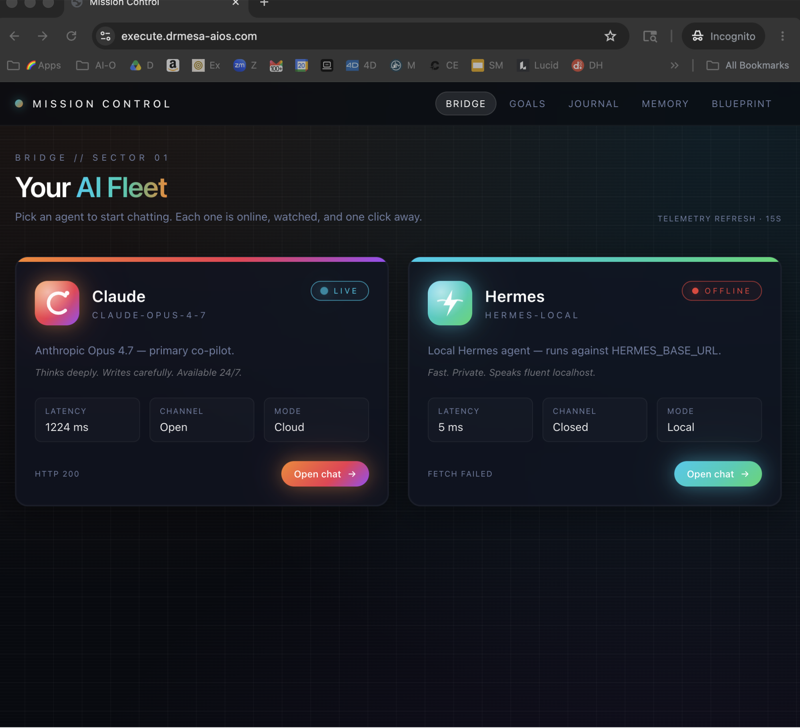
- Bot rosters and agent-to-agent comms. Since v0.21 Pantheon landed on 31 August, Hermes runs persistent named bot rosters that message each other, plus an in-app browser driver. On an Omarchy machine that means a standing team of agents native to the OS, not one throwaway chat session.
- Slash-command workflows. Commands like /goal, /plan and /bg drive real work from the CLI — I've broken down how I use them in my /goal command guide. With Hermes set as Omarchy's default terminal agent, those commands become muscle memory.
- The desktop app when you want a window. The same agent with a GUI — my Hermes desktop app review covers it properly, including where it shines and where it doesn't.
Fully local on Linux is the real story
Here's the pairing that makes this more than a convenience feature. On 4 September, one-click local model setup landed in Hermes Desktop, with NVIDIA backing it on Windows and Linux: it reads your hardware, picks a model, and configures the runtime for you, with Unsloth GGUFs like Qwen3.8-27B and DeepSeek-V4-Flash supported — I covered the details in my local model setup guide. Put that next to a Linux distro integration and you get the sentence that actually matters: an Omarchy machine with an NVIDIA card can run a fully local, fully private agent, with your files, prompts and memory never leaving the box. If you'd rather hold the reins yourself, the manual Ollama route remains for full control over models and quants. Either way, Omarchy plus Hermes plus a decent GPU is the most private agent workstation I can currently point anyone at.
📺 Watch: Hermes AI Agents Just Went Portable
Honest notes before you commit
Two caveats worth knowing. First, there's an open question from the announcement thread that I haven't seen answered: whether computer use — the agent driving the GUI — works inside Omarchy. Nobody had confirmed it either way at the time of writing, so if that's core to your workflow, test it before you commit or watch the official channels. Second, some users criticise the Hermes desktop app's UX polish; I'll report that neutrally — the engine draws few complaints, the chrome around it draws some. Terminal-first Omarchy users mostly won't care. One housekeeping note too: the AI menu's contents will evolve, and Hermes' first-class support is the only integration that's been formally announced, so check omarchy.org for the menu's current state rather than trusting any article — including mine — to stay current forever.
Do you need Omarchy to run this agent?
No, and it's worth being straight about that. Hermes is cross-distro: one user in the thread runs it happily on Fedora, and it works on essentially any system you'd realistically use. What Omarchy adds is the native-ness — the AI menu install, the default terminal agent slot, the theme sync. If you're already on Omarchy, the case for Hermes just became trivially easy. If you're not, don't switch distros for an agent; run Hermes where you are and let Omarchy earn the move on its own merits.
The bigger picture — agents joining the operating system
This announcement is my Agent OS thesis playing out at the operating system level. I've argued for months that the direction of travel is agents as infrastructure — owned workflows that live in your system, not rented chats that live in a browser tab. An agentic distro shipping a first-class agent is exactly that: on Omarchy, the agent stops being an app you open and becomes something the OS assumes is there. And if you're weighing which model to run behind the agent once it's installed, that's what I built Goldie Bench for — real agentic tasks rather than trivia benchmarks.
One pointer for readers arriving from the other direction: I covered this same announcement from the Hermes user's side — what the deal signals about the agent's roadmap — in my Hermes-on-Omarchy piece. This page is for the Omarchy user choosing an agent; that one is for the Hermes user watching where the project is heading.
What you get on Omarchy, at a glance
| What you get | How | Where it's from |
|---|---|---|
| Zero-friction agent install | Hermes desktop app in Omarchy's AI menu | Nous Research announcement, 9 September 2026 |
| Shell-native agent | Set Hermes as the default terminal agent | Same announcement |
| An agent that matches your desktop | Omarchy theme sets colours in the desktop app, TUI and CLI | Same announcement |
| Fully local, private models | One-click setup, NVIDIA-backed on Linux; Qwen3.8-27B and DeepSeek-V4-Flash GGUFs supported | Hermes Desktop, 4 September 2026 |
| Standing agent teams plus a browser driver | Persistent named bot rosters with agent-to-agent comms | Hermes v0.21 Pantheon, 31 August 2026 |
FAQ
What is the Omarchy AI agent?
Hermes is the agent with announced first-class support in Omarchy. Per Nous Research's 9 September 2026 announcement, it installs from the AI menu, can be set as the default terminal agent, and follows your Omarchy theme across the desktop app, TUI and CLI.
Is the agent preinstalled on Omarchy?
It ships in Omarchy's AI menu per the announcement — a menu-driven install rather than something you fetch by hand. The menu's exact contents change over time, so check omarchy.org for the current state before planning around it.
Can the Omarchy AI agent run local models?
Yes. The one-click local setup that landed in Hermes Desktop on 4 September — NVIDIA-backed on Linux — reads your hardware, picks a model and configures the runtime, and the manual Ollama route remains for full control. On an NVIDIA-equipped Omarchy box, the whole agent can run offline.
Do I need Omarchy to use Hermes?
No. Hermes is cross-distro — one thread user runs it on Fedora without drama. Omarchy simply makes it native, with the menu install, the terminal-agent default and the theme sync.
Is computer use supported inside Omarchy?
That's the open question from the announcement thread, unconfirmed either way at the time of writing. If GUI-driving is central to your workflow, test it yourself or check the official channels before committing to it.
My verdict
If you run Omarchy, install Hermes from the AI menu and set it as your default terminal agent. It's the announced first-class option, the integration shipped working on day one, and paired with the one-click local setup it turns an Arch box with an NVIDIA card into a genuinely private agent workstation. The desktop app's polish will keep improving and the computer-use question will get its answer; neither changes the call. The Omarchy AI agent question has a clear answer this week — and it's the same agent I'd run on any distro. Omarchy just makes it feel like part of the operating system, which is exactly where all of this is heading.
Want to turn a native agent into an income system instead of a toy? Join me in AI Profit Lab and I'll hand you the agent workflows that pay for themselves — or book a free SEO strategy session and we'll plan your Omarchy agent stack one-on-one.