Agentic AI OS for founders is what I now build my whole working day around as a solo operator running multiple businesses. It is not another SaaS, it is the operating system underneath every AI tool I use, and once I plugged Grok into Hermes inside it this week the stack went from useful to genuinely team-level. Solo founders do not need more apps, we need fewer apps that actually talk to each other.
This post is the founder view of an Agentic AI OS. I will cover what it is, why a solo operator needs one, the Hermes plus Grok backbone, the three commands that wire it together and the Studio section that finally collapsed my content stack.
🔥 Get the full Agentic AI OS as an AIPB bonus AI Profit Boardroom members get the Agent OS zip file, 100 prompts, 30-day roadmap, plus Hermes Agent + Claude OS launch kit. → Get inside
Why Solo Founders Need An Agentic AI OS
Most founders I speak to have between eight and fifteen AI subscriptions. ChatGPT, Claude, Midjourney, Grok, ElevenLabs, Perplexity, Zapier, and a content tool or two. Each one is a tab and each tab has its own memory of you, which is to say none.
The cost of that setup is not the monthly fee. It is the cognitive tax of remembering which tool to open, the loss of context every time you start a new chat, and the lack of any compounding improvement over time.
An Agentic AI OS replaces that mess with one shell, one memory and one dashboard. Every agent inside it shares context, remembers your business, and can hand off work without you copying anything between tabs.
For a founder, that is the difference between AI as a tool and AI as a team.
What Counts As An Agentic AI OS
An Agentic AI OS has four properties that distinguish it from a normal AI tool. If you lack any of these, you have an assistant, not an OS.
The first property is shared memory. Every agent in the system can read and write to the same store, so what one agent learns the others know.
The second is multi-modal execution. The system can produce and consume text, image, video and voice in one workflow, not separate apps.
The third is local-first hosting. The OS runs on your own machine and your data never leaves unless you explicitly send it.
The fourth is coordination. Agents can spawn, hand off, and run in parallel under a single mission control view.
My stack hits all four through Hermes, Grok, Claude, OpenClaw, Obsidian and OMI working together.
The Hermes Plus Grok Backbone
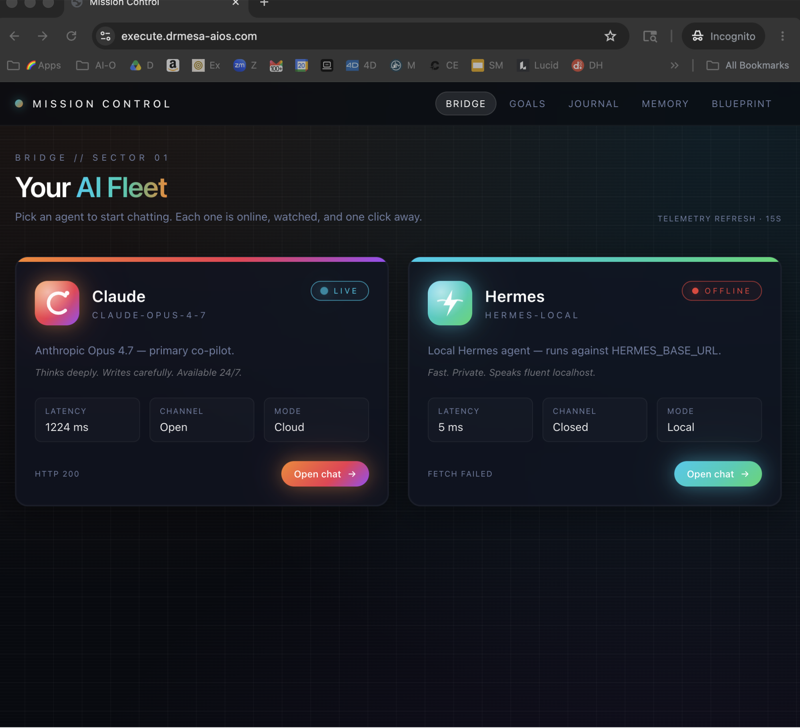
Hermes is the agent framework I run at the centre of my Agentic AI OS. It is the thing that hosts the other tools, holds memory and exposes the dashboard. Without Hermes I would have a shelf of disconnected models. With it I have a coordinated stack.
For most of 2025 Hermes was strong on text but weak on multi-modal. It needed something that could see live signals, render images, generate video and speak. Grok plugged in this month and provided exactly that bundle.
When Grok joins Hermes through the new XAI auth flow, the OS gains four new senses simultaneously. Eyes via X search. Hands via Grok Imagine image generation. A camera via Grok video generation. A voice via Grok text to speech. All for the cost of an X subscription you may already be paying.
That single integration is what made me start calling this an Agentic AI OS rather than a Hermes setup.
Three Commands To Wire It Together
The setup is shorter than most onboarding flows. Three commands inside Hermes and one browser login is the whole thing.
The first is hermes update. That pulls the build with the Grok auth flow ready to go. Skip this and the model picker will not show the XAI option.
The second is hermes model. That opens the model picker, you pick XAI Grok Auth, and a browser window appears for you to log in with your X account. Once you authorise it, the token is stored locally.
The third is hermes tools. That opens the tools menu where you enable X search, image generation, video generation and text to speech. Tick all four and they appear inside your Agent OS dashboard as live capabilities.
Two minutes of terminal work and your OS just gained four modalities.
What Each Modality Unlocks For Founders
X search is the founder superpower. You can build agents that monitor competitors, listen to your audience and react to trending niche topics in real time without ever opening Twitter yourself.
Image generation through Grok Imagine ships hero images, thumbnails and social graphics on demand. Quality option set to best gives you near-stock-photo polish in under a minute.
Video generation through Grok ships short clips of 25 seconds or so that are good enough for hooks, B-roll and ad creative. I tested it with cyberpunk dragon prompts and the output went straight into a YouTube intro.
Text to speech turns any agent into a voice. I use it for draft podcast scripts, sales video voice-overs, and quick voice memos sent to clients. The Grok voice clears the human-realism bar most TTS still misses.
For a founder, those four modalities collapse roughly four SaaS subscriptions into one.
The Goldie Mission Stack — Four Layers
The architecture I use to keep this whole thing tidy is what I call the Goldie Mission Stack. Four layers, each with a clear job.
Layer one is Intelligence. Claude and Claude Code handle reasoning, planning and writing. They are the brain.
Layer two is Execution. OpenClaw handles the clicks and keystrokes. It is the hands that turn a Claude plan into real actions on your machine.
Layer three is Research. Hermes plus Grok handle live signals, X search and multi-modal generation. They are the senses.
Layer four is Self. Obsidian plus OMI hold your personal context, notes and voice transcripts. They are the memory.
Without layer four, every other layer is generic. With layer four, every other layer becomes uniquely yours.
The Self Layer Is The Unlock Most Founders Miss
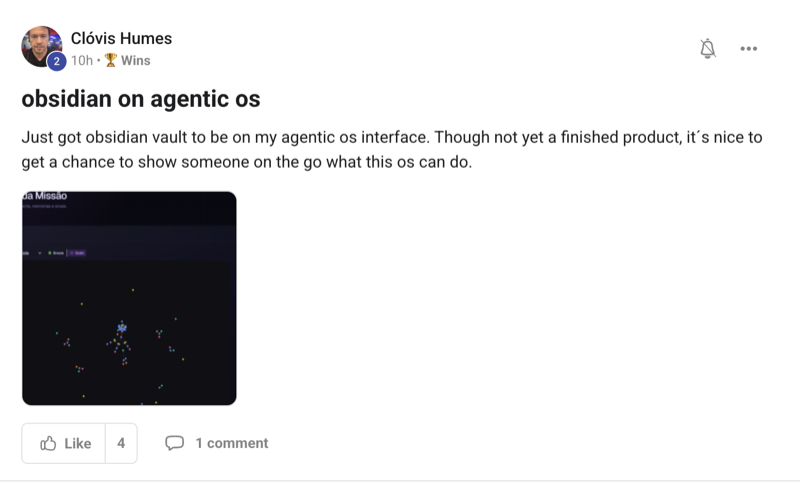
The Self layer is what turns generic AI into AI that knows your business. Obsidian holds every SOP, offer description, transcript and decision log. OMI captures voice notes throughout the day and pipes them into Obsidian automatically.
When I ask Hermes a question that references my vault, I get answers shaped around Goldie Agency, AIPB and my actual customer base. I do not have to keep re-explaining my context because the OS already has it.
The compounding effect is huge. Every voice note, every meeting transcript and every blog post becomes training data for the next prompt. Six months in, the stack knows me better than most contractors do.
That is the layer most founders skip. It is also the one that creates the biggest gap between an Agentic AI OS and a pile of disposable chats.
The Studio Section — Multi-Modal Content On Tap
The newest addition to my OS is a Studio section. It was built into the dashboard with a single prompt to Claude Desktop and it now hosts every visual and audio job in one place.
Inside Studio I can generate images, videos and speech in parallel. One tab is rendering a video while another is writing voice. A third is producing a static image. Everything gets saved to history so I can grab assets later without re-running prompts.
For a founder producing content daily, this is the part that bought back the most hours. A workflow that used to need Midjourney, Runway, ElevenLabs and Premiere now runs inside one OS in a fraction of the time.
Watch The Walkthrough
For the broader Hermes context I recommend pairing this with my Hermes Agent OS post so you can see how the dashboard hangs together end to end.
Why Local-First Beats Cloud For Founders
A founder cannot afford to lose access to their workflow because a SaaS vendor changed terms overnight. Local-first solves that.
Privacy is the first reason. Your customer data, your SOPs and your voice notes never leave your machine. Cloud platforms turn that into training data and that is a bad trade for a business.
Speed is the second. Local memory reads and writes are instant. Cloud agents pause every few seconds to round-trip, which kills the flow state when you are trying to ship.
Resilience is the third. If a model provider changes pricing, your workflows still run because the OS is yours.
Comparison Table — SaaS Stack Vs Agentic AI OS
| Category | Typical Founder SaaS Stack | Agentic AI OS |
|---|---|---|
| Monthly cost | £300+ across many tools | One X subscription plus local stack |
| Memory across tools | None | Shared Obsidian vault |
| Image generation | Midjourney or DALL-E | Grok Imagine inside Studio |
| Video generation | Runway or Pika | Grok video inside Studio |
| Voice | ElevenLabs | Grok TTS inside Studio |
| Real-time web | Perplexity | Grok X search |
| Personalisation | None | Trained on your vault |
| Parallel execution | One tab at a time | Multi-agent fan-out |
That table is the elevator pitch for why founders are migrating off SaaS shelves and onto Agent OS stacks this year.
🚀 Need an AI agent stack for your agency? Book a free SEO + AI Strategy Session with Goldie Agency. → Book free session
Daily Founder Workflows On The OS
My morning starts with an X search digest. Hermes pulls trending topics across my niche, Claude summarises them, and I get a one-page brief in Obsidian before I open email.
By mid-morning I am usually in Studio shipping a piece of content. One prompt produces the script, the hero image, the short-form video and the voice-over. What used to take half a day now takes thirty minutes.
In the afternoon I run client work through the same OS. The Self layer means every output is shaped around the client brand because the brand profile lives in Obsidian.
In the evening I queue overnight tasks for OpenClaw to execute while I sleep. Mornings now arrive with finished jobs in my inbox.
Founder ROI Math
Before this OS my realistic content output was roughly one full multi-modal piece per day. With the Agentic AI OS that is four to six pieces per day with better personalisation than I used to ship.
At my hourly rate that is the equivalent of an extra hire I do not have to pay for. The marginal cost is my existing X subscription plus a small amount of model spend through Claude.
If you charge for content or use content to drive offers, that is easily a five-figure swing per quarter from a stack you can build in an afternoon.
FAQs
Can a non-technical founder run this?
Yes. The three Hermes commands are copy and paste. The wiring is mostly clicking through dashboards. If you can install an app and follow a checklist, you can run this OS.
Do I have to use all four modalities?
No. Toggle on the ones you need and leave the rest off. Most founders start with X search plus text to speech and add image and video later.
Will this replace my current AI subscriptions?
In most cases yes. Founders I coach typically cancel three to five SaaS tools in the first month after going Agent OS.
What if I do not have an Obsidian vault yet?
Start a new one with your offer descriptions, ICP notes and a couple of SOPs. Even a small vault makes a big difference inside the Self layer.
Is the launch kit worth joining AIPB for?
If you want the Agent OS zip, the 100 prompts and the 30-day roadmap pre-built, yes. The weekly live coaching is the part most members rate highest.
When To Build An Agentic AI OS
If you ship content, run an agency, sell offers, or coach clients, you should build this stack now. The compounding from the Self layer alone makes the next quarter materially easier.
If you run a team, the OS becomes the shared brain that aligns everyone around the same context. That alone is worth the setup.
If you are pre-revenue and still finding product-market fit, the OS makes you faster at testing offers, scripts and creatives, which compresses the time to fit.
When To Wait
If you only use AI a few hours a week, this is too much infrastructure. A standard chat is fine until your usage grows.
If you are committed to a no-local-tools policy for compliance reasons, the local-first design will not fit your environment. Cloud-only Agent OS options exist but they trade away speed.
If you are deep into a single SaaS that you love, you do not need to rip it out. Plug it into the OS instead.
FAQ — Agentic AI OS For Founders
How long until it pays back?
Most founders see the time saved exceed the setup within the first week. Content-heavy founders see it within the first day.
How is this different from Zapier or Make?
Those are workflow tools that move data between SaaS apps. This is an operating system for agents that think, act and remember. Different category.
Is Grok essential to the OS?
You can run an Agentic AI OS without Grok, but you lose the eyes, the image, the video and the voice in one go. It is the single biggest unlock in the stack right now.
What hardware do I need?
A modern Mac or PC with 16GB of RAM is fine. The heavy lifting still happens through model APIs so you do not need a GPU.
Can a team share one OS?
Yes. You can run a shared Obsidian vault for team context and individual agent shells per person. That is the setup my agency uses internally.
Latest Updates
- Hermes AI Agent Framework 2026 — the framework that powers the Research layer.
- Hermes Computer Use — the Execution layer that handles real clicks and keystrokes.
- Claude Hermes Agent — the Claude plus Hermes pairing at the heart of the Intelligence layer.
Further Reading On Agent OS Guide
For deeper walkthroughs on the topics in this article, the Agent OS Guide library has these worth bookmarking.
- Agent OS Guide — the full library of agent OS walkthroughs and setups.
- Hermes Agent OS Q&A — quick answers on running Hermes as an agent OS.
- NotebookLM Agent OS — using NotebookLM as the memory layer for an agent OS.
- Agent OS Member Testimonials — real builds and results from inside the Agent OS Guide community.
Also On Our Network
- 🌐 Read on bestaiagentcommunity.com
- 🌐 Read on juliangoldieaiautomation.com
- 🌐 Read on aisuccesslabjuliangoldie.com
- 🌐 Read on aimoneylabjuliangoldie.com
Related Reading
- Hermes Agent OS — the full Agent OS breakdown that this post builds on.
- Hermes Agent Installation Guide 2026 — the install path I recommend for new members.
- Hermes MCP Server — how to expose Hermes capabilities to other agents in your OS.
- OMI Obsidian — the wearable plus vault combo that powers the Self layer.
- Hermes Agent HUD UI — the dashboard that ties every layer together.
📺 Video notes + links to the tools 👉
🎥 Learn how I make these videos 👉
🆓 Get a FREE AI Course + Community + 1,000 AI Agents 👉
Agentic AI OS for founders is the single biggest leverage move I have made this year — wire Grok into Hermes, plug in your Obsidian vault, and watch your SaaS shelf shrink while your output multiplies.