Claude Hermes Agent is the founder delegation stack I wish I'd had five years ago, and after running it daily across my agency and my personal businesses I'm convinced it's the single highest-ROI free upgrade a solo operator can make in 2026. Claude does the thinking, Hermes does the doing, and the MCP bridge between them turns a chatbot into a chief of staff that actually ships work.
This post is the founder view of the Claude Hermes Agent stack — why it's an unfair advantage, the ROI math I've calculated for my own businesses, and the exact delegation loop I use to spend more time on strategy and less time clicking buttons.
🔥 Want the full Claude+Hermes setup + 100 prompts? AI Profit Boardroom has the 30-day roadmap, full setup SOPs, custom-video daily Q&A, plus 4 weekly coaching calls with 2,900+ entrepreneurs. → Get inside
Why Claude Hermes Agent Matters For Founders
Founders have one constraint that almost nothing else can fix.
Time.
You can hire help, you can buy tools, you can read books, but you cannot create more hours in the day.
The Claude Hermes Agent setup is the closest thing I've seen to a time-printing machine because it removes the entire category of work I call "operator tasks" — clicking around, copy-pasting between tools, sending reminder emails, running reports.
Claude reads what you want.
Hermes does it.
You get back to the work only a founder can do.
The Goldie Delegation Loop — Three Layers I Run Every Day
I designed the Goldie Delegation Loop to mirror how I delegate to humans.
Layer one is the Brain.
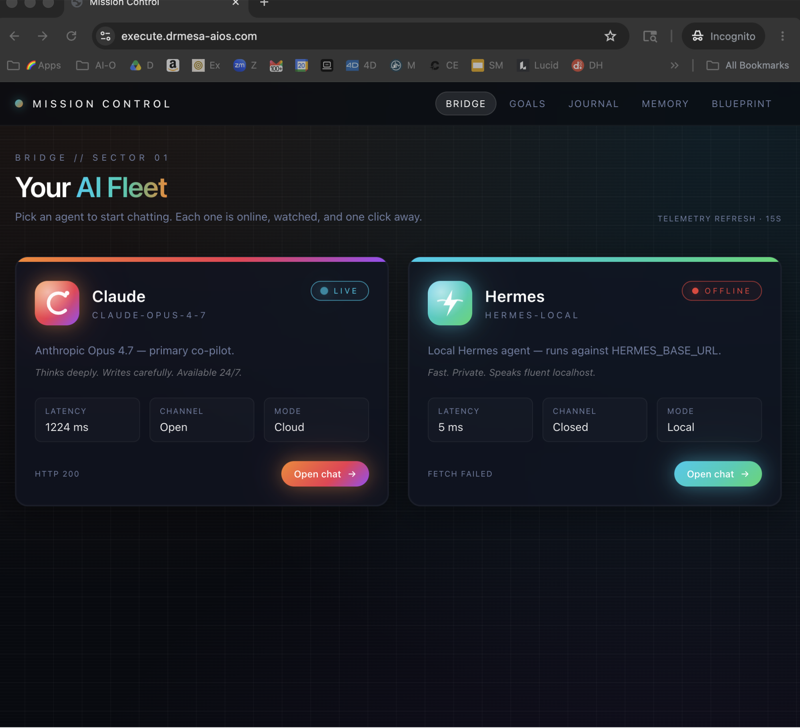
Claude sits at the top of the stack as the CEO — it thinks, it plans, it makes calls, it decides what to do next.
Layer two is the Bridge.
Hermes MCP connects Claude to Hermes Agent in real time and 99% of AI users don't have this installed yet.
Layer three is the Hands.
Hermes Agent does the physical work — browse the web, send emails, create documents, schedule cron jobs, message people, store long-term memories.
The loop runs in five steps.
You speak.
Claude thinks.
Hermes acts.
Results come back.
You delegate again.
Run that loop ten times a day and you've effectively added a full-time assistant to your business at zero marginal cost.
ROI Math For The Typical Founder
Let me show the actual numbers because most founders underprice their own time and miss the size of the unlock.
A typical founder spends roughly 2 hours a day on operator tasks — inbox triage, reports, content posting, follow-ups, status updates.
That's 10 hours a week.
That's 500 hours a year.
If you value founder time at £200 an hour — which is conservative if you're allocating capital, doing sales, or shipping strategy — that's £100,000 a year of founder time eaten by tasks a competent assistant could do.
Claude Hermes Agent doesn't replace 100% of those hours.
In my own use it replaces roughly 60% — call it 6 hours a week of recovered founder time.
That's £60,000 a year of founder time printed back into your week from a 15-minute install of a free tool.
The math is silly.
The 15-Minute Setup For Founders
You don't need to be technical for this.
You open Claude Desktop or Claude Mobile.
You paste in the Hermes MCP GitHub link and ask Claude to install it.
Claude reads the repo, configures the MCP connection, and restarts.
When it reopens, Hermes MCP is in your connectors panel ready to use.
Total time on my install was 15 minutes flat.
If something goes wrong — usually a permissions prompt — Claude will tell you what to fix.
I've watched non-technical members of my Boardroom do this install live on coaching calls and the average completion time is 18 minutes.
Bypassing The Claude OAuth Restriction — The Cost Story
Here's the part that matters for the ROI calculation.
Claude has stopped letting Hermes Agent connect via plain OAuth login.
Their pitch is that you should pay for Claude API access if you want Hermes to use Claude's brain.
API access at agency volume is hundreds to thousands of pounds a month.
The MCP bridge sidesteps that completely.
Hermes runs on your Claude subscription rather than your Claude API budget.
That single decision saved my agency roughly £400 a month and saved me personally another £80 a month on solo work.
Multiply that across the team and we're at roughly £6,000 a year of subscription savings on top of the founder-time savings.
This is the kind of architectural decision that compounds.
A Founder Day With Claude+Hermes Running
Here's what a real day looks like for me with this stack live.
At 7am I open my morning brief, which Hermes prepared overnight — inbox summary, calendar, top three priorities, news on three competitors.
At 8am I'm in deep work for the first big block — usually strategy, sales calls, or content recording.
Mid-morning I delegate four or five tasks to Claude in plain English — "Hermes, schedule a follow-up to this lead in 5 days," "Hermes, pull a brief on this trending topic," "Hermes, draft my Friday digest using the last 7 days of stats."
Mid-afternoon I review what Hermes has produced — most of it ships with minor edits, the rest gets one round of revision.
By 5pm I commit the day's work, ship anything outbound, and queue tomorrow's overnight jobs.
The pattern that matters is this — I went from running operator tasks all day to managing an agent stack while doing founder work.
The Brain-Bridge-Hands Pattern Beats Single-Tool Setups
Most founders run AI in one of three ways.
They use Claude as a chatbot.
They use Hermes manually.
They build custom code to wire things together.
All three are sub-optimal compared to the Claude Hermes Agent stack.
Claude alone can think but can't act on the world.
Hermes alone can act but you're driving it manually like a Photoshop user.
Custom code wires things together but costs developer time and locks you into your own implementation.
The MCP bridge wins because it's standard, free, and lets the best brain in the world drive the best hands in the world.
The whole point of the three-layer pattern is that each layer is replaceable.
If a better brain ships in 2027, you swap the brain.
If a better hands layer ships, you swap the hands.
The bridge keeps the architecture intact.
Test Cases I Ran On Day One
I'm a believer in verifying a stack works before scaling it.
On day one of my install I ran four tests in order of increasing complexity.
Test one was the trivial cron job.
"Hermes, schedule a job that says hello at 8am every day."
Hermes returned a job ID, name, scheduled task ID, next run time, and a sample output line.
At 8am the next morning the job fired exactly as scheduled.
Test two was a skills query.
"Hermes, what skills do you have access to?"
Claude pulled the full categorised list back through MCP.
Test three was a cleanup.
"Hermes, cancel all scheduled tasks."
Done in two seconds.
Test four was a real workflow.
"Hermes, schedule daily AI automation news research at 7am every day and save the brief to my morning folder."
It created a daily-automation-news task that has been running flawlessly for weeks.
If those four tests pass on your install, the rest of the stack works too.
What I Automated First
When you've got a working delegation loop, the temptation is to automate everything immediately.
Don't.
Start with the three highest-friction tasks in your week.
For me those were:
Daily inbox summary at 8am with action items pulled out.
Weekly performance digest emailed every Friday at 5pm to my team.
Monthly client reports auto-assembled and emailed on the 1st.
Those three workflows alone bought me back four hours a week.
Once those are humming, you layer on the next three, then the next three.
By month three you've moved 60-80% of operator work onto the agent stack.
Permissions And Safety For Founders
The single most expensive mistake a founder can make with this stack is granting too much permission too fast.
I run my Hermes MCP on "needs approval" for the first two weeks.
Every tool call pops a confirmation.
It's slightly annoying.
It's also exactly what saves you from the day Claude reads a prompt-injected document and tries to send 400 emails to your wrong list.
After two weeks of clean behaviour, move read-only tools to "always allow" but keep destructive tools — email send, file delete, payments — on approval.
This is a one-time setup decision that protects you for years.
Claude Alone Vs Claude+Hermes Vs Claude API Direct
| Setup | Cost To Founder | Action Capability | Memory | Best For Founders |
|---|---|---|---|---|
| Claude alone | Subscription | None — chat only | Within chat only | Pure thinking partner |
| Claude + Hermes MCP | Subscription only | Full Hermes capability | Persistent, growing | Daily delegation loop |
| Claude API direct | Per-token (scales fast) | Yes via custom code | Whatever you build | Engineering teams only |
For founders, the middle row is the only sensible answer.
You get full delegation capability without burning API tokens or hiring an engineer.
Persistent Memory Is The Secret Compounding Asset
The under-discussed superpower of this stack is Hermes's persistent memory.
Hermes remembers context across conversations.
It builds reusable skills the more you use it.
Your personal knowledge base grows on autopilot.
When you talk to Claude through MCP, Claude can reference everything Hermes has stored — your preferences, your tone, your team's structure, your client list.
That means month six is dramatically better than month one because the agent stack knows you now.
I pair this with OMI Obsidian for a second-brain feed that piles even more context into Hermes over time.
This is what makes the loop feel like a chief of staff instead of a chatbot.
🚀 Are you a marketing agency? Want SEO + AI combined? Book a free strategy session with my 7-figure SEO agency Goldie Agency (50-person team). → Book free session
Common Founder Objections I Hear Weekly
Three objections come up every week from founders considering this stack.
The first is "I'm not technical enough."
If you can type a sentence into Claude you can install this.
The whole config is "paste the GitHub link, confirm permissions, ship."
The second is "this'll take months to learn properly."
Setup is 15 minutes.
First automation is 30 minutes.
Total time from zero to running a real workflow is under an hour.
The third is "AI tools change too fast, why bother."
The skill of delegation is permanent.
The implementation changes.
Whoever has been running brain-bridge-hands loops for two years already will have a six-month lead on whoever starts in 2027.
When Claude Hermes Agent Wins Hardest For Founders
Solo founders see the biggest unlock because they have no team to absorb operator work.
Agency owners come second — every owner I've shown this to has moved at least one full role's worth of work onto the stack within a month.
Content creators with multiple platforms see massive wins on scheduling, research, and digest workflows.
Coaches and course creators win on community management, follow-up sequences, and weekly digests to their members.
If your business has more than 30 minutes of recurring operator work per day, you're a candidate for this stack.
When To Not Use Claude Hermes Agent
Be honest about where the stack falls short.
Highly regulated industries where audit trails matter need additional logging on top of what Hermes ships with.
Mission-critical security work needs human review on every action — don't put Hermes in charge of anything money-moving without a human in the loop.
Highly bespoke workflows that don't map to existing Hermes skills still need a custom build.
For everything else — and "everything else" is 80% of founder work — this is the stack.
FAQ — Claude Hermes Agent For Founders
Is the Claude Hermes Agent setup really free for founders?
Yes — Hermes MCP is free and runs on your existing Claude subscription. No API costs.
How much founder time does it actually recover?
In my own use, roughly 6 hours a week. At £200/hour founder time that's £60,000 a year of recovered capacity.
Will this work for a solo founder with no technical help?
Yes — that's exactly who it's built for. Install is 15 minutes, no code required.
What's the difference between this and just using Claude as a chatbot?
Claude alone can think but can't act. Claude + Hermes can think AND act on your behalf — that's the entire point.
Can I run this on Claude Mobile?
Yes — same MCP setup, works on Claude Mobile once your Hermes Gateway is reachable.
Should I upgrade to AI Profit Boardroom for help?
If you want the full 30-day roadmap, 100 prompts, daily Q&A, and weekly coaching with 2,900+ entrepreneurs, yes. The 7-day refund makes it risk-free to try.
What happens if Anthropic changes Claude's MCP support?
MCP is now an industry standard with multiple model providers supporting it. The bridge isn't going anywhere.
Latest Updates
- Hermes Agent Goals (NEW Persistent Update FREE) — the autonomous goal loops that pair perfectly with Claude as the brain.
- Sonnet 4.8 Review — the model I default to as the brain in this stack.
- Hermes Agent HUD UI — the visual layer that makes the Claude+Hermes loop legible at a glance.
Also On Our Network
- 🌐 Read on bestaiagentcommunity.com
- 🌐 Read on juliangoldieaiautomation.com
- 🌐 Read on aisuccesslabjuliangoldie.com
- 🌐 Read on aimoneylabjuliangoldie.com
Related Reading
- Hermes AI Agent Framework 2026 — the framework powering the hands layer.
- Hermes Agent Installation Guide 2026 — the deep-dive install walkthrough.
- Claude Code SEO Agent — Claude Code paired with SEO automation.
- OMI Obsidian — the second-brain layer that feeds context into this stack.
📺 Video notes + links to the tools 👉
🎥 Learn how I make these videos 👉
🆓 Get a FREE AI Course + Community + 1,000 AI Agents 👉
If you want the highest-leverage free upgrade of your founder year, the Claude Hermes Agent stack is it — install the MCP bridge today, ship your first automation tonight, and you'll wonder how you ever ran your business without the delegation loop.