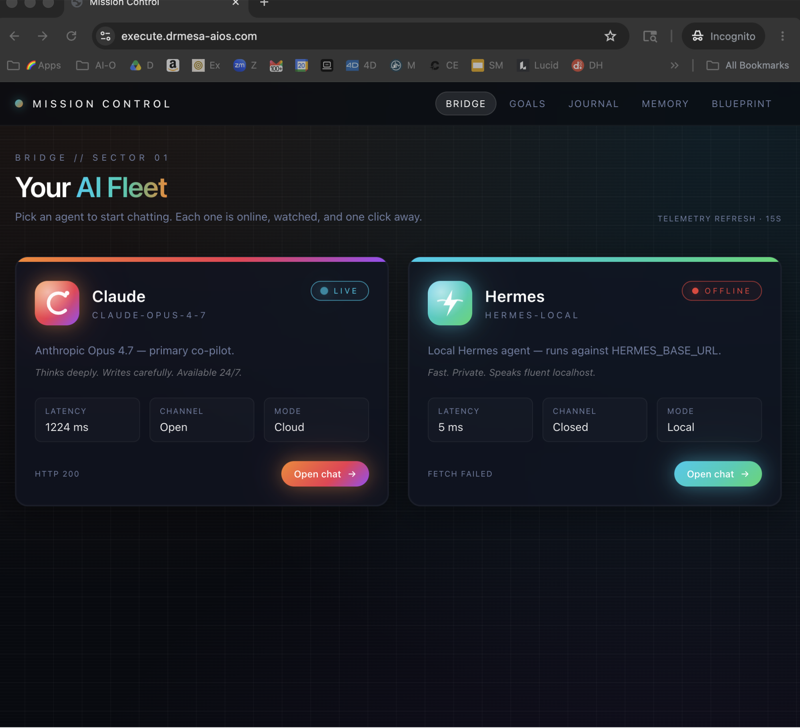
The Hermes agent HUD UI matters most for founders because it converts the operational chaos of running multiple agents in a terminal into a single visual screen you can actually skim in 30 seconds. After running it for the last few weeks alongside my existing Hermes setup, I'm convinced this is one of those quiet upgrades that pays back the install time on day one if you're a solo or small-team operator.
This is the founder-focused take on HUD UI. I'll cover what it actually unlocks for solo and small-team operators, where it fits in the broader Hermes stack, and the real time savings that make it worth the two-minute install.
🔥 Want my full Hermes founder stack training? AI Profit Boardroom has the deep-dive trainings on Hermes Workspace, HUD UI, agent swarms, and the whole founder agent stack plus weekly live coaching. → Get the trainings
Why Founders Need A Visual Layer
Solo founders and small operators end up running multiple Hermes agents simultaneously almost by accident. You start with one agent for content, add another for research, layer in a customer support FAQ agent, and before long you've got 5-10 agents running across different projects. Managing all that from the terminal is genuinely painful — you can't see what's broken until you check each one individually, and you can't chat naturally with any of them without context-switching between sessions.
HUD UI fixes this with a single browser dashboard where every agent, task, and chat session shows up in one place. For founders specifically, that visibility is the difference between feeling on top of your AI ops and feeling like things are slipping through the cracks.
What The Hermes Agent HUD UI Is At A Glance
Hermes HUD is a free open-source web UI for the Hermes agent framework. It installs as a Hermes plugin, runs locally in your browser, and exposes every part of your Hermes stack on a clean dashboard.
The standout features for founders are the in-browser chat, the live agents panel that shows everything running across your machine, the scheduled tasks manager for setting up recurring agent runs, the health diagnostics panel that flags broken API keys and dead providers before they bite you, and the one-screen model swap that lets you change defaults without restarting anything.
For two minutes of install time, you get a proper mission control screen.
Watch The Walkthrough
For the broader Hermes context that frames where HUD UI fits in the agent stack, this walkthrough covers the foundation you'll layer it on top of.
Hermes Agent HUD UI Setup Takes Two Minutes
Founders are time-constrained, so the install path matters. There are two routes and both are fast.
The first route is to copy the install command from the HUD UI repo and paste it into your terminal — standard Hermes plugin install. The second is the lazy route I recommend: open Hermes and ask it to "install this and sync it with Hermes" with the install command pasted in. Hermes installs the plugin itself and confirms when it's ready in the browser.
Either way, two to three minutes from start to a working dashboard. There's basically no reason for a founder using Hermes daily to not have HUD UI installed.
Real Founder Workflows On HUD UI
Three workflows that actually save founder time once HUD UI is set up.
The first is the morning agent review. I open HUD UI for two minutes at the start of the day, scan the agents panel for anything broken overnight, check the health diagnostics for expired API keys or down providers, and clear anything that needs attention. The five-minute upkeep saves me hours of "why isn't this working" debugging later.
The second is scheduled task creation. The schedule panel makes it trivial to spin up new daily or weekly agent jobs — research runs, content drafts, customer FAQ scans — without writing cron jobs. As a founder, removing friction from "create new automation" matters because friction is the difference between an automation existing and not existing.
The third is multi-agent coordination during heavy work. When I'm pushing on a product launch with multiple agents running on different parts of the project, HUD UI lets me see all their statuses in one screen and intervene only where needed. That replaces what used to be constant context-switching between terminal sessions.
Time Saved Per Week
Real numbers from running HUD UI as part of my founder stack.
Daily agent management dropped from 30-40 minutes of terminal switching to about 10-15 minutes of dashboard scanning. That's roughly 100-150 minutes per week recovered, just from having visibility in one place instead of scattered across sessions.
For a founder valuing time at £100 to £200 an hour, that's £200-£500 a week of time recovered from a free tool. The maths is so good it almost doesn't need explaining.
Cost To Run
HUD UI is genuinely free as open-source forever. The only running cost is whatever your underlying model provider charges for tokens.
If you're on local models via Ollama, total Hermes stack cost is £0 a month. If you're running cloud models like Sonnet 4.8, expect £20 to £200 a month depending on usage. For most founders, the all-in stack lands at £20 to £100 a month.
Where HUD UI Fits In The Founder Agent Stack
A founder running serious AI leverage in 2026 needs a few layers, and HUD UI is one of them.
The foundation is core Hermes itself — see Hermes AI Agent Framework 2026 for the install. Layered on top of that, Hermes Agent Goals gives you autonomous loops that run until a goal is met. Hermes Agent Swarm handles multi-agent orchestration when you outgrow single-agent work. And HUD UI is the visual layer that makes managing all of the above genuinely sustainable as you scale your agent count.
Pair that with OMI Obsidian for the second-brain memory layer and you've got the complete free founder agent stack.
HUD UI Vs Hermes Workspace For Founders
Both are free open-source web UIs, and the honest comparison matters because picking the right one saves time.
Hermes Workspace has a cleaner overall UI and ships with the Swarms feature for multi-agent work. If your founder workflow is heavily swarm-based, Workspace is probably the daily driver. HUD UI has more dense feature coverage and deeper diagnostics — better when you want maximum visibility into your stack.
For most founders, I'd start with one and add the other later if a specific gap emerges. I run both and they coexist fine, but you don't need to start there.
The Best Models To Pair With HUD UI
The model dropdown is one of HUD UI's quiet wins because you can swap defaults without restarting anything.
For coding-heavy founder work, Sonnet 4.8 is my default — see Sonnet 4.8 Review for why. For high-volume cheap workflows, Kimi K2.5 or MiniMax M2.5 are the budget alternatives that still hold up on agent work. For free zero-cost testing, the alpha model on OpenRouter is currently in beta and worth trying.
For most founders, Sonnet 4.8 as default with Haiku-tier fallbacks for triage tasks is the sensible setup.
Common Founder Mistakes With HUD UI
Three mistakes I've seen founders make in their first week.
The first is treating HUD UI as a replacement for the terminal entirely. Some things — quick one-off commands, low-latency interactions — are still faster in the terminal. Use HUD UI for management and visibility, the terminal for direct execution.
The second is ignoring the health diagnostics panel. Half of "why isn't this working" issues are flagged in health, so make checking it your default first move when something seems off rather than debugging from scratch.
The third is installing both HUD UI and Hermes Workspace simultaneously without checking for port conflicts. Both run locally and can collide if not configured. Install one at a time.
Founder Use Cases Worth Building On Top
Once HUD UI is running, these are the high-leverage agent workflows worth setting up next.
A daily content drafting agent that runs each morning and produces first-draft blog posts or social content. A daily research agent that pulls trending topics in your niche and summarises them. A customer support FAQ agent that handles common questions automatically. A lead enrichment agent that takes new leads and adds context from web data. A content repurposing agent that turns existing content into multiple formats.
All five run cleanly via HUD UI's scheduled tasks panel and show up in the agents view so you can monitor them at a glance.
🚀 Want hands-on founder coaching? AI Profit Boardroom has weekly live coaching for founders building AI-leveraged operations on Hermes. → Join here
Privacy For Founder Use
HUD UI runs entirely locally on your machine, which means your dashboard data never leaves your infrastructure. The only network calls are to whichever model providers you've configured.
For founders working with sensitive client data, you can pair HUD UI with local-only Ollama models for full privacy. The dashboard, scheduling, and management all work the same regardless of which model you're using underneath.
Daily Founder Routine
Here's what a real day looks like with HUD UI.
At 7am I open HUD UI and check the agents panel and health diagnostics. Anything broken from overnight gets cleared in 5-10 minutes. Mid-morning I spin up any new scheduled tasks I want running for the week. Throughout the day I glance at HUD UI maybe 3-4 times to see what agents are working on. Late afternoon I review what's been produced — content drafts, research summaries, customer responses — and ship what's ready.
Total time spent on agent ops sits at maybe 30-45 minutes a day. Output across content, research, ops, and customer support is multiples of what I'd produce solo without the agent stack.
When HUD UI Won't Be Enough
Be realistic about the limits.
HUD UI doesn't include native multi-agent swarm orchestration the way Hermes Workspace does, so heavy swarm users will probably want Workspace as the primary tool. It also won't make a poorly-set-up Hermes stack work better — fix the underlying Hermes config first. And it won't replace strategic thinking about which workflows to automate, which is still a founder decision.
FAQ — Hermes Agent HUD UI For Founders
Is HUD UI free for commercial founder use?
Yes — open-source and free for any use including commercial work.
Setup time?
Two to three minutes via either install path.
Best for solo founders?
Yes — the visibility win is biggest when you're running multiple agents alone.
Will it scale to a team?
It runs locally per-machine, so each team member would need their own install pointed at shared infrastructure or their own Hermes setup.
Better than Hermes Workspace?
Different sweet spots. Workspace for swarms and clean UI. HUD UI for diagnostics and feature density. Most pros run both.
Worth installing today?
If you run Hermes daily, yes. The install is two minutes and the time savings start immediately.
Worth Boardroom upgrade for the wider training?
For AI-leveraged founders serious about the agent stack, yes. The trainings on Workspace, swarms, goals, and Kanban inside the Boardroom plus weekly live coaching pay back the membership in weeks.
Latest Updates
- Hermes Agent Goals (NEW Persistent Update FREE) — autonomous loops that pair perfectly with HUD UI's scheduled tasks panel.
- Sonnet 4.8 Review — the model I default to inside HUD UI for coding work.
- 🌐 Read on bestaiagentcommunity.com — sister-site take on the same topic.
Also On Our Network
- 🌐 Read on bestaiagentcommunity.com
- 🌐 Read on juliangoldieaiautomation.com
- 🌐 Read on aisuccesslabjuliangoldie.com
- 🌐 Read on aimoneylabjuliangoldie.com
Related Reading
- Hermes AI Agent Framework 2026 — the core agent framework HUD UI runs on top of.
- Hermes Agent Goals — autonomous loops that pair perfectly with HUD UI's scheduled tasks panel.
- Hermes Agent Swarm — multi-agent orchestration patterns for when you scale beyond single agents.
📺 Video notes + links to the tools 👉
🎥 Learn how I make these videos 👉
🆓 Get a FREE AI Course + Community + 1,000 AI Agents 👉
For solo founders and small-team operators, the Hermes agent HUD UI is the visual leverage layer that turns scattered terminal sessions into a single mission control screen — install it this week and you'll feel the difference by Friday.